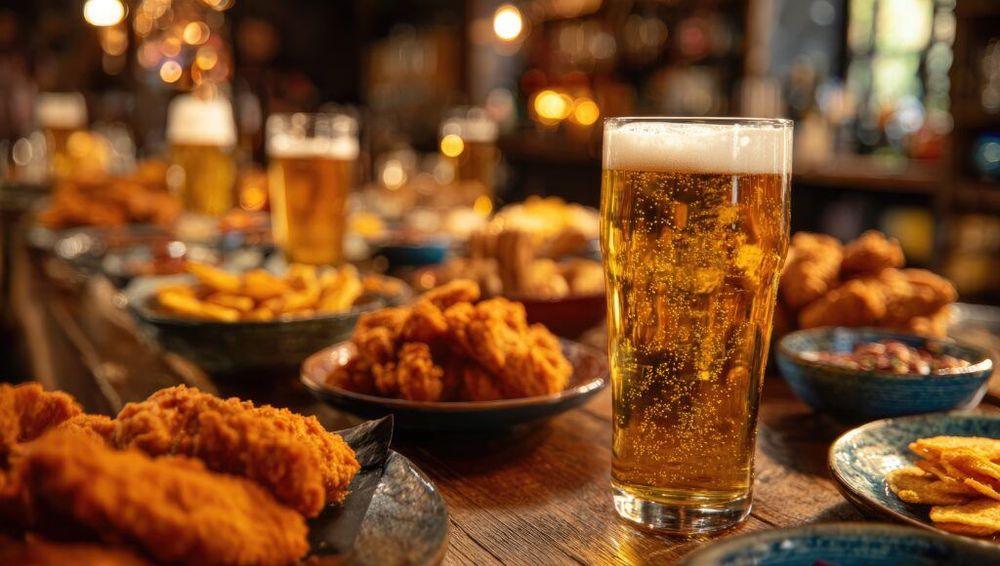

There is a specific kind of craving that only fried food satisfies.
Not just crispy food. Not just hot food. Fried food — the kind with a shatteringly thin crust that gives way to something tender and juicy underneath, that stays crispy long enough to actually eat without rushing, that doesn’t leave your fingers coated in grease and your stomach feeling like a regrettable decision.
The version you get at a good restaurant hits all of those marks. The version that comes out of a home kitchen rarely does.
The oil is the same. The ingredients are the same. The temperature looks the same on the thermometer.
What’s different is almost everything else.
The Oil Temperature Is Lying to You
Home cooks who fry carefully use a thermometer. They heat the oil to 350°F, verify it, and add their food. They’re doing the right thing — except the temperature they’re reading is the temperature before the food goes in.
The moment cold food hits hot oil, the temperature of that oil drops. Significantly. In a home pot with a limited volume of oil over a residential burner, adding even a modest amount of food can drop the oil temperature by 50°F or more — and a residential burner cannot recover that heat quickly.
The food now sitting in oil that’s closer to 300°F than 350°F is not frying. It’s slowly absorbing oil while the crust forms too gradually to seal the exterior properly. The result is food that’s greasy, dense, and pale — not because you did anything wrong procedurally, but because the physics of your cooking environment worked against you.
Professional fryers solve this two ways: large volumes of oil with significant thermal mass that resist temperature drops, and powerful heating elements that recover lost heat almost immediately. At home, the closest approximation is using more oil than feels comfortable, frying in smaller batches than feels efficient, and giving the oil time to fully recover between each batch.
Patience between batches is not optional. It’s the difference between the first piece — which is usually good — and everything that follows.
The Food Wasn’t Ready to Fry
Before a professional kitchen fries anything, the food has been prepared in ways that most home cooks skip entirely.
Moisture is the enemy of a good fry. Water on the surface of food hitting hot oil causes violent spattering and steam that prevents the crust from forming cleanly. Professional cooks dry their proteins thoroughly — pressing between paper towels, leaving uncovered in the refrigerator to air-dry, sometimes for hours — before they go anywhere near oil.
For breaded items, the breading process itself is more deliberate in a professional kitchen. The standard three-step process — flour, egg wash, breadcrumb — isn’t just a sequence, it’s a system. The flour dries the surface and gives the egg something to grip. The egg creates a tacky layer that holds the breadcrumb. The breadcrumb forms the crust.
Each layer needs to be applied with intention: flour shaken off so only a thin coating remains, egg wash covering every surface completely, breadcrumbs pressed firmly into the food rather than just rolled through a tray. And then — crucially — the breaded item rests on a rack for several minutes before frying, allowing the coating to set and adhere. Fry it immediately and the coating slides. Let it rest and it holds.
The Batter Has Been Thought About
For battered foods — fried chicken, fish and chips, tempura, onion rings — the batter itself is a recipe that professional kitchens develop and test rather than something thrown together at the last minute.
Temperature matters enormously. Cold batter hitting hot oil creates a better crust than room-temperature batter — the thermal shock sets the exterior quickly before the interior has time to absorb oil. Some professional kitchens use ice-cold carbonated water in their batter specifically because the carbonation creates bubbles that make the crust lighter and more aerated.
Thickness matters too. A batter that’s too thick produces a heavy, doughy crust that overwhelms the ingredient inside. Too thin and it slides off before it has a chance to set. Professional cooks test their batter by coating a finger or a spoon — it should coat evenly and cling without running off immediately, but not be so thick it drips in a heavy stream.
And resting the batter — allowing it to hydrate for twenty to thirty minutes before use — develops the gluten just enough to give the crust structure without making it tough.
The Frying Vessel Changes Everything
Here’s something most home cooks never consider: the shape and material of what you’re frying in has a significant impact on the result.
A wide, shallow pan loses heat to the air from a large surface area. A narrow, deep vessel retains heat more effectively and requires less oil to achieve a proper frying depth. Professional fryers are designed to maximize oil volume and minimize heat loss — deep, insulated, with powerful heating elements positioned for even distribution.
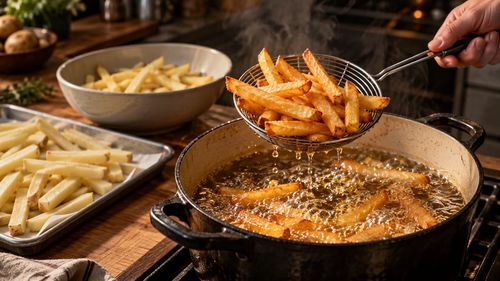
At home, a heavy Dutch oven is significantly better for frying than a wide skillet. The depth allows food to be submerged rather than half-fried, the heavy walls retain heat better than thin stainless, and the narrower opening reduces heat loss to the air.
The oil depth matters too. Food frying in oil that only comes halfway up its side is cooking unevenly — one half frying, one half steaming. Professional frying submerges the food completely or close to it, producing an even crust on every surface simultaneously.
Draining Is a Technique, Not an Afterthought
What happens in the thirty seconds after food comes out of the oil determines whether the crust stays crispy or turns soft.
Most home cooks drain fried food on paper towels. Professional cooks drain on wire racks.
The difference: paper towels trap steam underneath the food, and steam is moisture, and moisture softens crusts. A wire rack allows air to circulate completely around the food, moisture escapes in every direction, and the crust stays crisp for significantly longer.
The food also gets seasoned immediately after it comes out of the oil — while the surface is still tacky from the heat — because salt applied at this moment adheres and penetrates in a way that salt added at the table never can. Restaurant fried food is seasoned in the kitchen, the moment it’s drained, every single time. It’s why it tastes seasoned all the way through rather than just salty on the outside.
The Takeaway
Frying at home will never fully replicate a professional fryer — the equipment gap is real and the physics are unforgiving. But understanding why home frying falls short points directly to what can be improved.
Dry the food thoroughly. Build the breading with intention and let it rest. Keep the batter cold. Use a deep, heavy vessel with more oil than feels necessary. Fry in small batches and wait for the oil to recover. Drain on a rack and season immediately.
Each step closes the gap a little further. And the distance between home fried food made with professional awareness and home fried food made without it is not a small one.