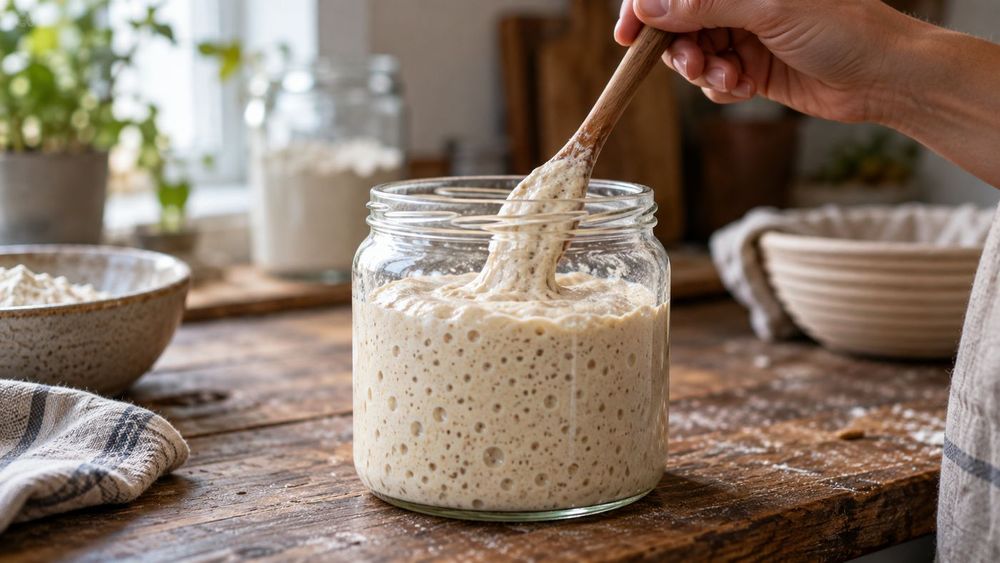

A jar of flour and water, left uncovered on a counter for a week, somehow turns into something alive — bubbling, rising, smelling faintly sour, with the power to leaven bread without a single packet of commercial yeast ever touching it.
It looks like a kitchen trick. It's actually a small, functioning ecosystem, built entirely from what was already floating in the air and sitting dormant in the flour itself.
Where the Yeast in Sourdough Actually Comes From
Commercial yeast comes from a single, cultivated strain, bred specifically for reliable, fast fermentation. Sourdough starter works completely differently, relying on wild yeast that already exists naturally on grain, in the air, and on kitchen surfaces.
Flour isn't sterile. It carries wild yeast spores and bacteria on its surface before it ever reaches a jar, which is part of why a starter can begin developing activity within days of simply combining flour and water, with nothing else added.
Why Bacteria Matter Just as Much as Yeast
A sourdough starter isn't just wild yeast working alone — it's a partnership between yeast and lactic acid bacteria, living in the same environment and depending on each other in ways researchers are still fully mapping out.
The bacteria produce lactic and acetic acid as they feed, which is where sourdough's distinctive tang comes from. That acidity also helps create an environment hostile to unwanted, potentially harmful bacteria, which is part of why a healthy, active starter is remarkably resistant to contamination despite sitting out at room temperature indefinitely.
Why Every Starter Tastes Slightly Different
Two starters made with identical flour, water, and technique, in two different kitchens, will develop noticeably different flavor profiles over time.
The specific wild yeast and bacteria strains present vary by region, by kitchen, even by the specific flour brand used, since each source carries a slightly different microbial population. This is part of why sourdough bakers sometimes describe their starter as having a distinct "personality," and why a starter shared between bakeries in different cities rarely tastes identical once established locally.
What "Feeding" a Starter Is Actually Doing
Regularly discarding part of a starter and adding fresh flour and water isn't wasteful ritual — it's directly managing the microbial population living inside it.
Without regular feeding, the yeast and bacteria eventually consume all available food, building up acidity and byproducts to a point where the culture weakens or dies off. Feeding resets that balance, providing fresh food and diluting excess acidity, which keeps the population active and capable of leavening bread reliably.
A neglected starter isn't necessarily dead — it can often be revived with a few consistent feedings, since the organisms inside it are more resilient than they seem.
How to Actually Keep a Starter Healthy
A few consistent habits are usually enough to maintain an active, reliable starter.
Feed with equal parts flour and water by weight, roughly once every 24 hours at room temperature
Look for consistent bubbling and roughly doubling in size within 4–8 hours of feeding as signs of health
Store in the fridge and feed weekly if not baking often, to slow activity without stopping it entirely
Discard part of the starter before each feeding to keep the population size manageable
None of this requires special equipment — just a jar, a scale, and a bit of routine.
The Takeaway
Sourdough starter isn't a shortcut or a novelty. It's a living culture, built from organisms that were already present in the flour and the air, working together in a relationship bread bakers have been relying on for thousands of years without ever needing to understand the microbiology behind it.
That jar on the counter isn't just an ingredient. It's the oldest form of leavening still in regular use, quietly doing chemistry that commercial yeast simplified but never replaced.