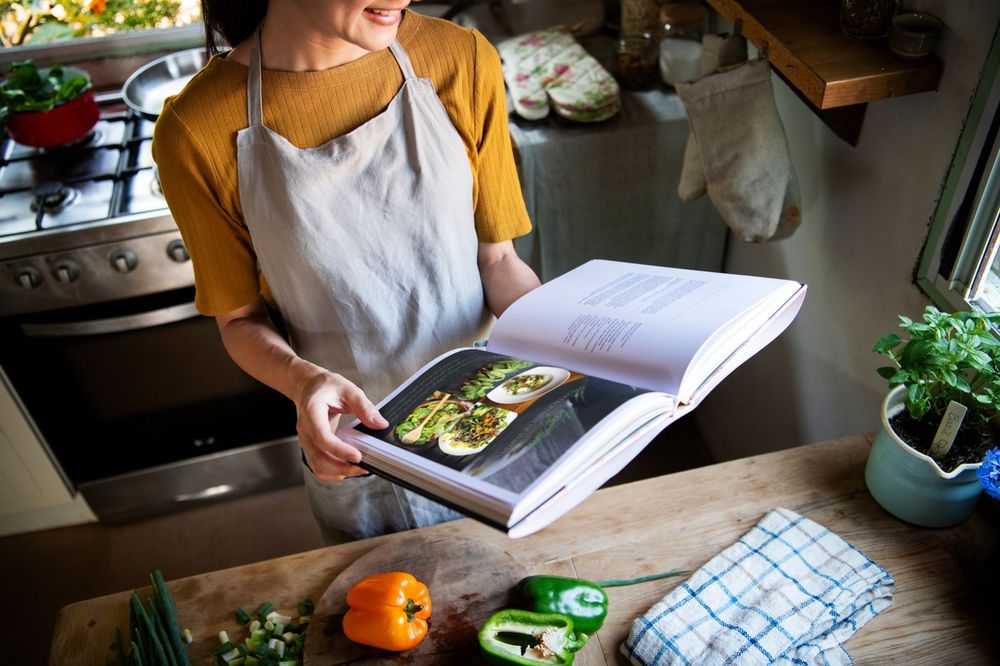

There are cookbooks that contain recipes.
And then there are cookbooks that contain a way of thinking about food — a philosophy, a set of values, a particular lens through which every ingredient and every technique is understood differently than it was before.
The first kind is useful. The second kind is transformative.
Most home cooks have encountered both without necessarily being able to articulate the difference. A useful cookbook produces good meals. A transformative one produces a different cook — someone who stands at the stove differently, who shops differently, who asks different questions about what food is and what cooking is for.
These books don’t announce themselves as transformative. They often look, from the outside, like recipe collections. But something in them — a voice, a philosophy, a way of explaining not just what to do but why — changes the reader in ways that persist long after any specific recipe has been forgotten or adapted beyond recognition.
Understanding what makes a cookbook transformative — rather than merely useful — is worth thinking about for any cook who reads them.
The Cookbook That Teaches You to Taste
There is a category of cookbook that prioritizes the development of the cook’s palate over the transmission of specific recipes — that treats learning to taste as the foundational skill from which everything else follows.
Samin Nosrat’s Salt, Fat, Acid, Heat belongs to this category in a way that few books published in the last decade do. Its central argument — that mastery of four elements produces good cooking regardless of the specific recipe being followed — shifts the cook’s attention from instruction to understanding. The reader doesn’t just learn what to do. They learn why it works. And a cook who understands why a technique works can adapt it, apply it to new situations, and troubleshoot when something goes wrong — all things that a cook who has only learned what to do cannot do with the same fluency.
The books that teach a cook to taste — that develop the internal calibration that makes seasoning decisions feel instinctive rather than calculated — tend to produce the most lasting change in how a cook operates. The recipe is forgotten. The palate it trained remains.
The Cookbook That Changes How You See Ingredients
Some cookbooks produce a shift not in technique but in relationship — they change the way a cook looks at a specific category of ingredient, revealing complexity and possibility that the cook had never suspected.
Yotam Ottolenghi’s Plenty — a book organized around vegetables at a time when vegetable-forward cooking was far less mainstream than it has since become — did this for a generation of home cooks who had treated vegetables as supporting players and suddenly understood them as the most interesting thing on the plate. The book didn’t just provide vegetable recipes. It provided a new way of seeing what a vegetable could be — marinated, charred, layered with unexpected flavors, treated with the same care and ambition that cookbooks had previously reserved for proteins.
A cookbook that changes how you see an ingredient changes what you cook. Permanently. The home cook who encountered Plenty and genuinely engaged with it did not go back to treating vegetables as an afterthought. Something had shifted in their understanding of what a vegetable was capable of, and that shift didn’t require the book to be consulted again to persist.
The Cookbook That Gives You Permission
There is a particular kind of transformative cookbook that operates not by teaching new technique or revealing new possibility but by giving the reader permission — permission to cook more simply, to trust their instincts, to abandon the anxiety of perfection in favor of the pleasure of genuine cooking.
Marcella Hazan’s Essentials of Classic Italian Cooking does this for Italian cuisine in a way that remains unmatched. Its voice — direct, warm, opinionated, occasionally impatient with unnecessary complexity — communicates something that goes beyond its recipes: that good Italian cooking is not about elaborate technique or expensive ingredients but about quality, simplicity, and a willingness to trust the process.
The famous butter and onion tomato sauce — which contains three ingredients and requires two hours of almost completely passive cooking — is in this book not as a recipe for a specific occasion but as a statement of values. The sauce is the argument. The argument is that simplicity, done with patience and quality ingredients, produces something that complexity cannot improve upon.
The reader who encounters this argument and accepts it is a different cook afterward. Not because they know more, but because they are less anxious — because they have been given permission, by a voice they trust, to cook the simple thing and trust that it will be enough.
The Cookbook That Connects Food to Something Larger
Some of the most transformative cookbooks are transformative not primarily because of what they teach about cooking but because of what they reveal about the relationship between food and everything else — culture, history, memory, identity, the way we understand ourselves through what we eat and how we prepare it.
Diana Kennedy’s The Cuisines of Mexico — published in 1972, at a time when Mexican food in the United States was understood primarily through Tex-Mex — documented with extraordinary precision and respect the regional cooking traditions of a country whose cuisine was, outside its borders, almost entirely misrepresented. Kennedy’s book didn’t just provide recipes. It argued, through its meticulous documentation of specific regional traditions and specific local ingredients, that Mexican cuisine was one of the great culinary traditions of the world — a complexity of flavor and technique that the American understanding of “Mexican food” had completely failed to recognize.
Books like this change more than cooking. They change the way a reader understands a culture. And a reader who understands a cuisine as a cultural document — as the accumulated expression of a people’s relationship with their land, their history, and each other — cooks from it differently than a reader who understands it only as a set of recipes.
The Cookbook That Teaches the Why Behind the What
The technical cookbook — the one that explains the science behind the technique, that reveals what is actually happening when an onion is softened or a stock is reduced or a custard is set — produces a specific and lasting kind of transformation.
Harold McGee’s On Food and Cooking is not, strictly speaking, a cookbook. It contains almost no recipes. It is an encyclopedic account of the science behind every major category of food and cooking — why bread rises, why meat browns, why emulsions form and break, what heat does to protein at different temperatures. It is the book that explains the why behind every what of cooking.
The cook who has read it — or even significant portions of it — operates differently in the kitchen. Not because they are thinking consciously about the science while they cook, but because the science has informed their intuitions. When something goes wrong, they have a framework for understanding what happened and why. When a technique is described to them, they can predict what it will produce before they try it. The science becomes the invisible foundation beneath the intuition.
More accessible books in this tradition — J. Kenji López-Alt’s The Food Lab, for example — bring the same scientific rigor to a more recipe-forward format, explaining the reasoning behind every technique choice in a way that teaches the reader to understand rather than simply to execute.
What Makes a Cookbook Last
Most cookbooks are consulted for specific recipes and set aside. The transformative ones are read — not just referenced, but read as books, with the same kind of sustained engagement that fiction or philosophy is read with.
The difference is in the presence of a genuine point of view. A cookbook that argues for something — that has a position on what matters in cooking, why it matters, and how the reader’s understanding of food should change as a result of engaging with it — gives the reader something to engage with beyond recipes. The argument is what persists. The recipes are the evidence.
The best cookbooks are not recipe delivery systems. They are conversations — between the author’s deep knowledge and experience and the reader’s curiosity and hunger — that produce something in the reader that didn’t exist before the book was encountered.
That something is the mark of a transformative book. And it is the thing that distinguishes, in any cook’s library, the books that changed how they cook from the books that simply told them what to make.
The Takeaway
Not every cookbook is worth reading rather than consulting. But some are — and the ones that are tend to share a quality that is easier to recognize than to define: the presence of a genuine intelligence thinking seriously about food, with a point of view strong enough to change the reader’s point of view.
Read the cookbooks that argue for something. Read them from the beginning, including the introductions that most readers skip. Engage with the philosophy before the recipes. And pay attention to the moment when something shifts — when a way of understanding food that wasn’t present before reading becomes present after.
That shift is what a cookbook, at its best, is capable of producing.
And it is worth looking for.