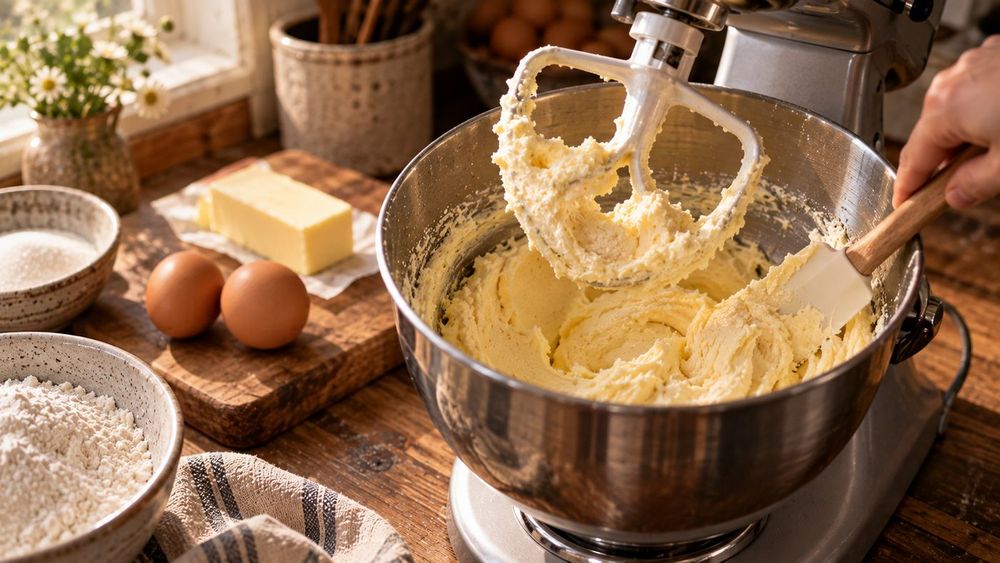

A recipe that calls for room temperature butter or eggs can look like an optional suggestion, easy to skip when there's no time to wait. Skip it enough times, though, and baked goods start coming out denser, greasier, or oddly uneven — without an obvious reason why.
Temperature isn't a formality in baking. It's often doing real structural work before the oven ever gets involved.
What Room Temperature Butter Is Actually Doing
Creaming butter and sugar together isn't just about combining ingredients — it's about trapping tiny air pockets inside the butter's fat structure, which later expand in the oven and help create lift.
Cold butter is too firm to trap air effectively, while melted butter has lost its structure entirely, unable to hold any air at all. Only butter at roughly 65–68°F has the right pliability to incorporate air properly during creaming, which is part of why a recipe made with cold butter can come out noticeably denser than the same recipe made correctly.
Why Room Temperature Eggs Blend Differently Than Cold Ones
Eggs straight from the fridge are more viscous and resistant to blending smoothly into a batter, especially one built around a creamed butter-and-sugar base.
Cold eggs added to room temperature butter can cause the fat to seize up and separate slightly, creating a curdled-looking batter that traps air less effectively. Room temperature eggs blend in smoothly, maintaining the emulsion the creaming process worked to build in the first place.
A batter that looks slightly broken or grainy partway through mixing is often a temperature mismatch, not a sign the recipe was followed incorrectly.
Why This Matters Less for Some Recipes Than Others
Not every baked good depends on this the same amount, which is part of why the rule sometimes feels inconsistent from recipe to recipe.
Recipes that rely heavily on creaming for their rise — cakes, many cookies — are far more sensitive to ingredient temperature than recipes leavened primarily by baking powder or baking soda reacting with liquid, where creaming plays a smaller structural role. Pie dough and biscuits actually want the opposite: cold butter, kept in solid chunks, for a completely different textural goal.
"Room temperature" isn't a universal baking rule so much as a specific tool, useful exactly where the recipe is depending on creamed fat for lift.
The Fastest Ways to Actually Get There
Waiting hours for butter to soften naturally isn't always realistic, and there are faster, reliable shortcuts that don't sacrifice the result.
Cut butter into small cubes to speed up warming, since more surface area equals faster temperature change
Submerge whole eggs in a bowl of warm — not hot — water for about 5 minutes
Grate cold butter on a box grater for baked goods that need it soft quickly
Avoid microwaving butter to soften it, since it's easy to accidentally melt part of it unevenly
Each of these gets ingredients to the right temperature in minutes rather than hours, without compromising the structure the recipe is depending on.
How to Tell When Butter Is Actually Ready
A visual check is more reliable than a clock, since kitchen temperature varies from day to day.
Properly softened butter should hold its shape but give easily to gentle pressure — a finger pressed into it leaves an indent without the butter collapsing or looking greasy and shiny. Butter that looks slightly translucent or oily at the edges has gone too far and has already started losing the structure creaming depends on.
The Takeaway
"Room temperature" in a recipe isn't a suggestion left over from a less precise era of cooking. It's describing a specific physical state that a lot of baking chemistry depends on to work correctly.
Skipping it doesn't ruin a recipe outright, but it often explains the gap between a cake that turns out dense and flat and the same recipe made with ingredients at the temperature it actually asked for.