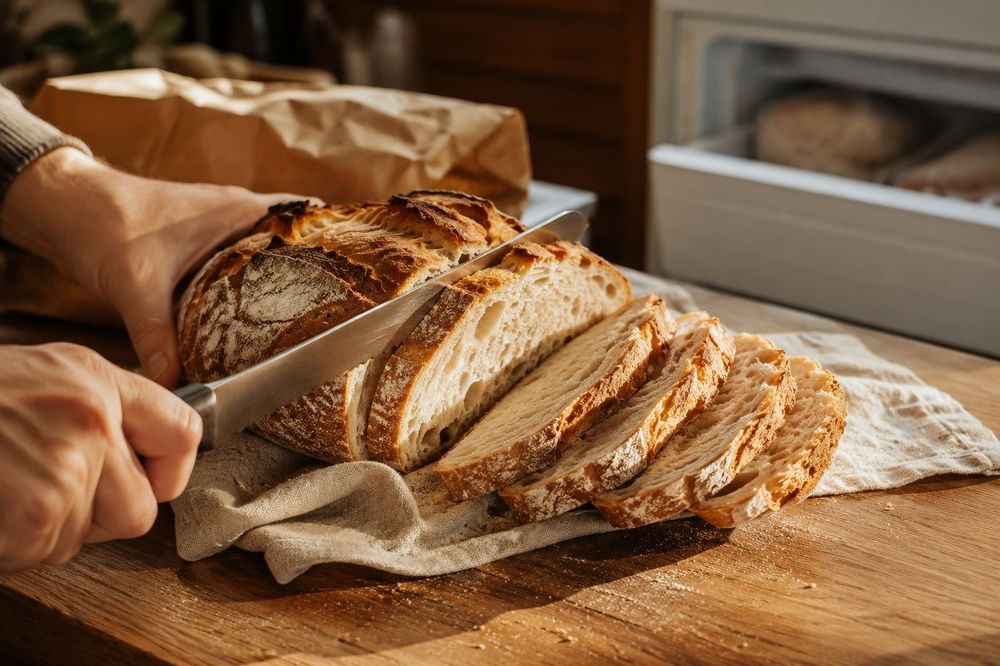

It feels like the responsible thing to do. A loaf of bread, already opened, gets tucked into the fridge to "keep it fresh longer." Days later, it comes out tougher and drier than bread left out on the counter the whole time.
That's not bad luck. It's basic starch chemistry working directly against the instinct to refrigerate it.
The Staling Process Isn't About Moisture Loss
Most people assume bread goes stale because it dries out. That's part of the story, but not the main one.
Staling is largely caused by a process called starch retrogradation, where the starch molecules in bread — gelatinized during baking — slowly recrystallize back into a more rigid structure over time. That recrystallization is what makes bread feel tough, dry, and crumbly, even if the actual moisture content hasn't changed much.
It's a structural change, not just an evaporation problem.
Why the Fridge Makes It So Much Worse
Starch retrogradation doesn't happen at a constant rate — it speeds up dramatically at refrigerator temperatures, somewhere around 35–40°F.
Bread stored in the fridge can go stale up to six times faster than bread left at room temperature. The cold that's supposed to preserve food is, in this specific case, accelerating the exact process that ruins it.
This is why day-old refrigerated bread often feels older than bread that's been sitting on the counter for three or four days.
Why Freezing Works Completely Differently Than Refrigerating
It seems counterintuitive that a colder environment could actually preserve bread better, but freezing and refrigerating aren't the same process at all.
Retrogradation slows dramatically at freezer temperatures, well below the range where it accelerates. Frozen bread essentially pauses the staling process almost entirely, rather than speeding it up like the fridge does.
Bread pulled from the freezer and properly thawed can taste nearly identical to the day it was baked — something refrigerated bread can rarely claim after even one day.
Why Some Staling Is Actually Reversible
Stale bread isn't always a lost cause, because heat can partially reverse the same process that caused the problem.
A few minutes in a warm oven re-gelatinizes some of the recrystallized starch, temporarily softening bread that's started to go stale. This is why day-old bread often tastes noticeably better after a quick reheat than it does at room temperature — the fix is genuinely undoing some of the chemistry, not just adding moisture back.
The effect doesn't last, which is why reheated bread goes stale again faster than it did the first time.
How to Actually Store Bread
The right method depends entirely on how soon it'll get eaten.
Room temperature, in a paper bag or bread box, works best for bread that will be finished within a couple of days
The freezer, tightly wrapped, is the better choice for anything that won't be eaten within a few days
The refrigerator is almost never the right call for bread, despite feeling like the safest option
Slicing before freezing makes it easy to pull out only what's needed, without thawing the whole loaf
The instinct to refrigerate bread makes sense for most other foods. Bread is one of the clear exceptions.
The Takeaway
Bread doesn't go stale because it's forgotten or old. It goes stale because of a specific, predictable chemical process — one that the refrigerator actually speeds up rather than prevents.
The fix isn't a special container or a new brand of bread. It's simply choosing the freezer over the fridge, and the counter over both when the timeline is short.
Once you understand what staling actually is, "keeping bread fresh" stops being guesswork.