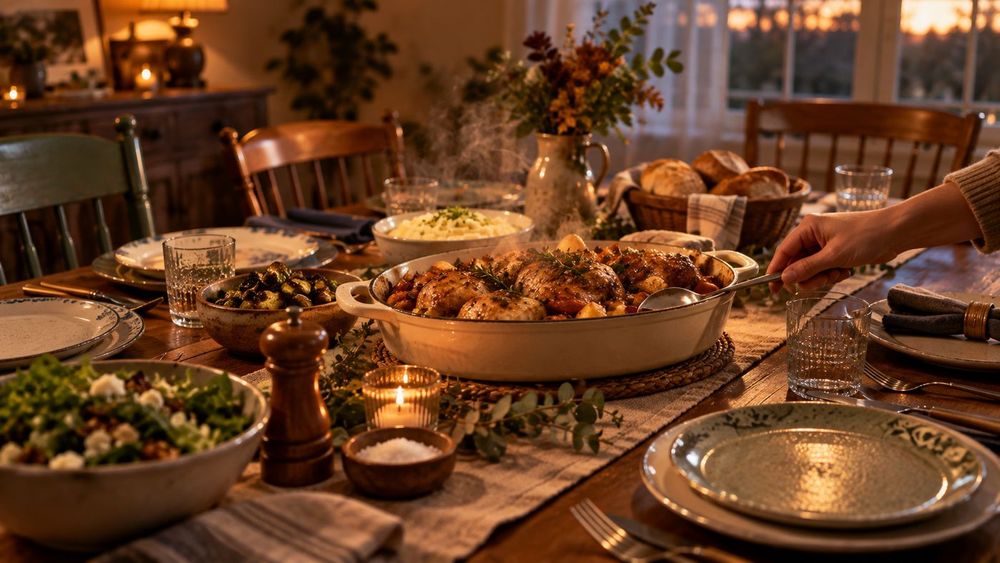

Somewhere along the way, eating together stopped being just a way to get calories into the body and became something closer to a ceremony — a specific time, a specific place, sometimes specific seats that never change no matter how many years pass.
Almost every culture on earth has some version of this. The foods differ wildly. The instinct underneath them barely does.
Why Eating Together Became the Default, Not the Exception
For most of human history, food was scarce, unpredictable, and required real labor to gather or hunt. Sharing a meal wasn't a nicety layered on top of survival — it was often survival itself, a way of pooling resources and strengthening the bonds that made cooperation possible.
Anthropologists studying early human groups have pointed to shared meals as one of the clearest, most consistent markers of social bonding across vastly different early societies, long before written language or formal religion existed to reinforce it.
Eating alone, by contrast, was often a sign that something had gone wrong — illness, exile, or simply bad luck.
How the Same Instinct Took Wildly Different Shapes
Once eating together became embedded in human behavior, every culture built its own specific rules on top of that shared foundation.
Some traditions center on a communal dish everyone eats from directly, like injera in Ethiopian cuisine or a shared pot in many Southeast Asian meals. Others insist on individual plates but rigid seating hierarchies, reflecting family structure or social status. Some cultures eat in near silence out of respect; others treat mealtime as the loudest, most talkative part of the day.
The specific rules vary enormously. The underlying idea — that a meal is something done with people, not just consumed — shows up almost everywhere.
Why Rituals Around Food Tend to Outlast Everything Else
Food traditions have a strange durability compared to other cultural practices. Languages shift. Clothing changes generation to generation. Specific recipes, seating arrangements, and mealtime habits often survive migration, assimilation, and centuries of change almost untouched.
Families who no longer speak their grandparents' language, or live nowhere near where their ancestors did, frequently still hold onto a specific dish, a specific way of setting the table, or a specific order in which people are served. Food rituals seem to encode identity in a way that's harder to lose than almost anything else.
This is part of why immigrant communities so often preserve culinary tradition more precisely than any other cultural marker — it becomes one of the last, most durable threads back to somewhere else.
What Gets Lost When Shared Meals Disappear
Modern life has quietly eroded a lot of these traditions — busier schedules, more meals eaten alone or on the go, screens replacing conversation even when people do sit down together.
Researchers studying family mealtime patterns have consistently found that regular shared meals correlate with stronger family communication and closer relationships, though correlation alone doesn't prove the meal itself is doing all the work. Still, the pattern shows up again and again across different studies and different cultures, suggesting there's something real happening at that table beyond just the food.
What seems to matter most isn't the specific menu. It's the dedicated, undistracted time the meal creates, almost by accident, simply by requiring people to sit still together for a while.
Small Ways to Bring the Ritual Back
None of this requires recreating an elaborate tradition from scratch. Most food rituals started small and grew meaning through repetition, not the other way around.
Eat at least one meal a day without phones or screens present
Keep the same rough time and place for a shared meal, even if the menu changes
Let a specific dish become "the" dish for a certain occasion, repeated on purpose
Sit down together even for something simple, rather than saving the ritual for special occasions only
The ritual isn't really about the food being impressive. It's about the repetition creating a container for something else to happen inside it.
The Takeaway
Every culture that has ever existed found its own way to turn eating — something every living thing has to do — into something closer to a ceremony.
The specific dish, the specific seat, the specific order things get served in: those details are almost never really about the food itself. They're about what gets carried alongside it, meal after meal, for long enough that it starts to feel like it was always there.