
There is a dish that contains, within a single bowl, more cooking knowledge than most recipes communicate in their entirety.
It is not a dish from a three-star restaurant. It is not the product of a culinary tradition that prizes elaborateness or technical display. It is, at its surface, a bowl of noodles in broth.
But ramen — genuine ramen, the kind produced by cooks who have spent years or decades understanding what the bowl requires — is one of the most technically demanding and philosophically rich dishes in the world. Every element of it has been considered. Every component is doing specific work. The broth alone may represent twelve, eighteen, twenty-four hours of careful cooking. The noodles are calibrated to the specific alkalinity that produces their characteristic texture and color. The tare — the seasoning concentrate added to each bowl — is a preparation of its own, separate from the broth, developed independently and combined at the last moment.
A bowl of ramen is a lesson in what happens when simplicity and complexity exist simultaneously — when a dish that looks like one thing is actually many things working together with extraordinary precision.
The Broth Is Not Soup
The first and most important thing to understand about ramen broth is that it is not soup in the conventional sense.
Most Western soup-making involves a relatively straightforward extraction: bones, vegetables, and aromatics are simmered in water until their flavor has transferred to the liquid, and the result is the soup. The process is designed to produce a clear, clean liquid — which is why professional soup stocks are never boiled, skimmed carefully, and strained with care.
Ramen broth — particularly tonkotsu, the pork bone broth that is the foundation of Hakata-style ramen — is made through a deliberately different process. The pork bones are boiled aggressively, at a full rolling boil, for twelve to eighteen hours or more. This violent cooking emulsifies the fat and collagen from the bones into the broth, producing a liquid that is opaque, intensely rich, and almost creamy in texture. The cloudiness that would be considered a flaw in a French consommé is the goal of tonkotsu — it is the visual evidence of the emulsification that produces the broth’s extraordinary body.
This requires a specific understanding of what the technique is doing and why — and a willingness to use it intentionally rather than accidentally. The ramen cook who produces a great tonkotsu broth knows something about emulsification, about collagen, about the specific temperatures and durations that produce the result they’re after, that translates directly to a deeper understanding of every stock and broth they will ever make.
The Tare Is the Secret Most People Miss
There is an element of ramen construction that is largely invisible to the person eating the bowl but that accounts for a significant portion of the flavor complexity that makes great ramen so much more interesting than its components individually suggest.
The tare.
Tare — pronounced tah-reh — is the seasoning concentrate added to each individual bowl before the broth is ladled in. It is what distinguishes shoyu ramen from shio ramen from miso ramen — the broth might be the same, but the tare changes the flavor profile of the finished bowl completely.
A shoyu tare is a complex soy-based preparation — not simply soy sauce, but soy sauce combined with mirin, sake, kombu, dried fish, and other aromatics, developed and aged into something far more complex than any of its individual components. A shio tare is built on salt — but salt combined with dashi and other elements that give it depth. A miso tare involves fermented soybean paste combined with other ingredients that round and deepen its inherent character.
The lesson the tare teaches is one of the most broadly applicable in all of cooking: seasoning and flavor development are not the same thing. The tare is not just making the soup salty. It is adding a fully developed layer of flavor — one that has been built separately, with its own technique and its own time — that combines with the broth to produce something neither could achieve alone.
This is the principle behind every great sauce, every well-developed pan reduction, every seasoning decision that goes beyond salt: the flavor has to be developed somewhere, not just added.
The Noodle Is Not an Afterthought
In most Western noodle dishes, the pasta is a neutral carrier — a vehicle for the sauce or broth that flavors it. The pasta itself is expected to be relatively neutral in flavor and its texture is the primary consideration.
Ramen noodles are not neutral carriers.
They are made with kansui — an alkaline solution containing potassium carbonate and sodium bicarbonate — that gives them their characteristic yellow color, their firm, springy texture, and their distinctive flavor that is slightly mineral, slightly eggy, and completely unlike either wheat noodles or egg noodles made without the alkaline component. The alkalinity of the noodle is calibrated to its intended broth — a richer, heavier tonkotsu broth calls for a thicker, more alkaline noodle that can stand up to it; a lighter, more delicate shio broth calls for a thinner, straighter noodle that won’t overpower it.
This calibration — the idea that a component of a dish should be developed in relationship to the other components it will interact with, rather than independently of them — is a principle that extends far beyond ramen. The pasta in a dish should be considered in relationship to the sauce. The bread in a dish should be considered in relationship to what it will carry. The specific character of one element should be developed in dialogue with the others.
The Bowl Is Architecture
A properly assembled ramen bowl is not a collection of ingredients added to broth. It is a constructed experience — an architecture of flavor, texture, and temperature that has been thought through from the bottom of the bowl to the surface.
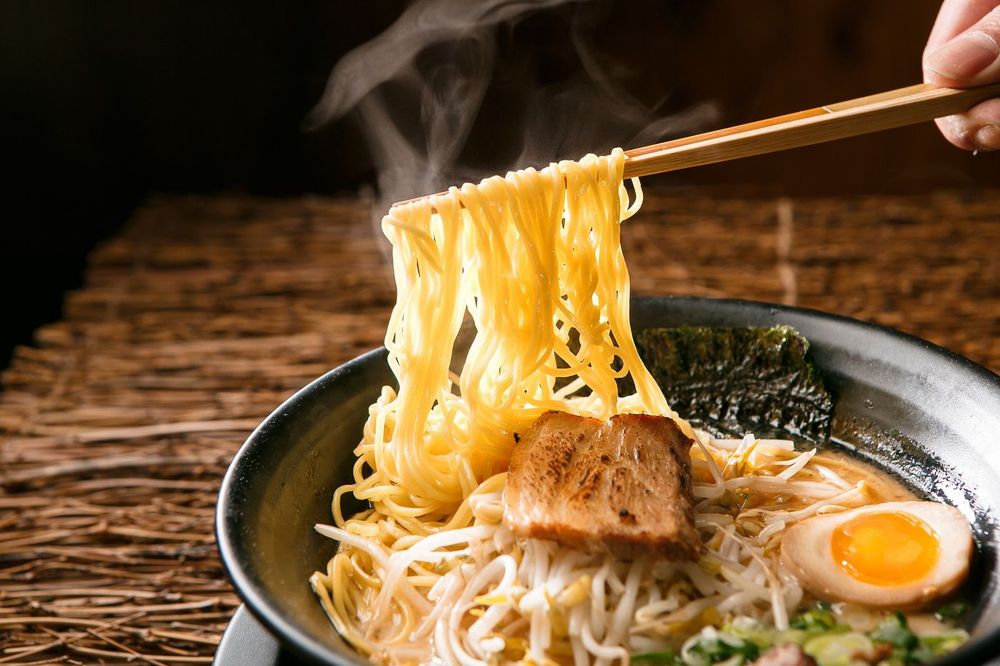
The tare goes in first. Then the fat — a measured pour of flavored oil or rendered pork fat that will rise to the surface of the bowl and create a thin, heat-retaining layer that keeps the broth hot longer. Then the broth, hot enough to continue cooking the elements added afterward. Then the noodles, cooked separately and added precisely when they are at the right texture. Then the toppings — chashu pork, marinated eggs, bamboo shoots, nori, scallions — each placed with attention to their position in the bowl.
The placement of toppings in ramen is not purely aesthetic. Different elements of the bowl are at different temperatures, have different textures, and deliver different flavor intensities. The diner who eats through the bowl encounters these elements in a sequence that has been considered by the cook — the rich, fatty chashu at one end, the clean, bright scallions at another, the umami-dense nori softening slowly as the meal progresses.
This is dish architecture — the principle that the spatial arrangement of elements in a dish affects the eating experience — applied with extraordinary intentionality. Every serious dish benefits from this thinking. Ramen makes it impossible to miss.
The Egg Is a Lesson in Precision
The marinated soft-boiled egg — the ajitsuke tamago — that appears in most ramen bowls is, in its own small way, a demonstration of everything that professional precision means in cooking.
The egg is soft-boiled to a specific internal temperature that produces a fully set white and a yolk that is set at the edges but still jammy and slightly liquid at the center — a texture that requires a cooking time measured in seconds rather than minutes to achieve consistently. It is then immediately transferred to an ice bath to arrest the cooking at exactly that point.
The cooled egg is then peeled and placed in a marinade — typically soy sauce, mirin, and sake — for a specific period of time. Too short and the marinade hasn’t penetrated through the white to season it properly. Too long and the exterior becomes overly salty and the texture of the white toughens. The window is specific, and the ramen cook who produces a perfect ajitsuke tamago consistently has learned, through repetition, exactly where that window is.
This is precision cooking applied to a single component of a single dish. The lesson it teaches — that every element of a dish deserves the same quality of attention as the dish as a whole — is one that applies to every plate any cook ever assembles.
What the Bowl Teaches
Ramen teaches patience — the willingness to give a preparation the time it actually requires rather than the time that is convenient.
It teaches layering — the understanding that a dish with depth is built from multiple preparations developed separately and combined at the last moment.
It teaches calibration — the principle that individual components should be developed in relationship to each other rather than independently.
It teaches architecture — the idea that the spatial arrangement of elements in a dish is part of the dish’s design.
And it teaches precision — the habit of attending to every component of a finished dish with the same care as the most prominent one.
These are not ramen lessons. They are cooking lessons. They apply to every dish in every cuisine — which is the mark of a great teaching dish.
The bowl of noodles in broth contains all of it.
You just have to know how to look.
The Takeaway
Ramen is a dish worth studying not because it is exotic or fashionable but because it is comprehensive — because the cooking knowledge embedded in a single well-made bowl covers more fundamental ground than most dishes ten times as elaborate.
Seek out a great bowl. Eat it slowly and pay attention to what is happening at each level of the experience. Then ask what made it taste the way it did — and follow that question wherever it leads.
The answer will take you somewhere useful.