
Every home cook has a list of equipment they want.
A better stand mixer. A larger Dutch oven. A carbon steel pan they’ve read about in three different places and keep meaning to buy. The kitchen scale that would make baking more precise. The immersion blender that would make pureed soups effortless.
These are reasonable things to want. Some of them are genuinely transformative. But the conversation about kitchen equipment — which tends to focus on the large, the expensive, and the aspirational — consistently overlooks a category of tools that produce an outsized impact on the quality of daily cooking for a fraction of the cost and attention they deserve.
These are not the glamorous tools. They are the ones that sit in a drawer, or should sit in a drawer, that get reached for constantly by serious cooks and ignored entirely by cooks who don’t know what they’re missing.
They are worth knowing about.
The Bench Scraper: The Tool That Changes How You Work
The bench scraper — a rectangular piece of metal with a handle along one edge — is one of the most useful tools in a professional kitchen and one of the least known in a home kitchen.
Its primary function, as the name suggests, is scraping — cleaning dough from a work surface, portioning bread dough, moving cut ingredients from a cutting board to a pan without the awkward business of cupping hands and hoping nothing falls. But the bench scraper’s utility extends far beyond these primary applications in ways that make it one of the most frequently reached-for tools in any kitchen where one is present.
For anyone who makes pastry or bread dough, the bench scraper is indispensable — it can divide dough cleanly and precisely, shape loaves by dragging them across a floured surface, and clean a work surface of stuck dough in seconds rather than the minutes of scrubbing that follow if the scraper isn’t used.
For everyday cooking, the bench scraper is the tool that replaces the awkward process of using the side of a knife to move chopped ingredients — a process that puts lateral stress on the knife blade and produces the particular inefficiency of scraping small pieces of onion across a cutting board with a tool designed for an entirely different purpose.
A bench scraper costs between eight and fifteen dollars. It occupies almost no space. And once a cook has one, they reach for it so constantly and use it so naturally that its absence in other kitchens becomes immediately noticeable.
The Kitchen Scale: The Tool That Makes Everything More Consistent
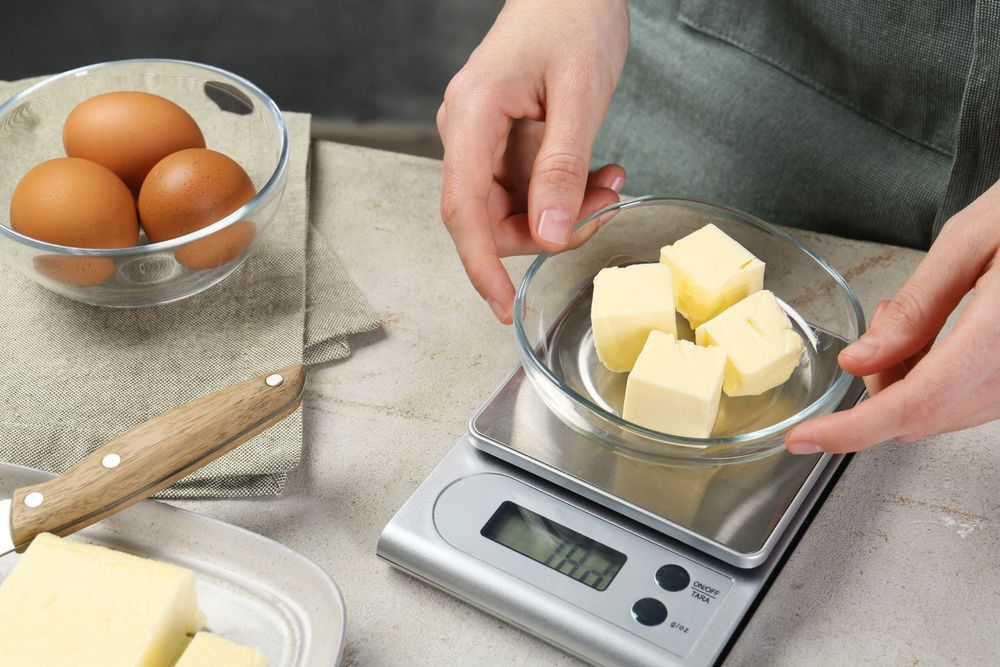
The kitchen scale is not unknown to most home cooks — its value for baking is widely understood, and scales have become significantly more common in home kitchens than they were a generation ago.
But the kitchen scale is consistently underused in ways that go beyond baking — and the home cook who uses it only for flour and sugar is using perhaps a third of its value.
Volume measurements — cups and tablespoons — are inherently imprecise in ways that matter for cooking as well as baking. A cup of flour can vary by as much as thirty percent in weight depending on how the flour was scooped, whether it was sifted, and how densely it was packed. A tablespoon of salt varies significantly depending on the grain size of the salt and how the spoon was filled.
For spice blends, for marinades, for any preparation where a specific balance of flavors matters and consistency between iterations is the goal, weighing rather than measuring by volume produces results that are reproducible in a way that volume measurements are not.
The kitchen scale is also the most efficient tool for portioning — for dividing dough into equal pieces, for ensuring that multiple portions of a protein are the same size and will therefore cook at the same rate, for scaling a recipe up or down with precision that volume measurement makes cumbersome.
A digital kitchen scale costs between fifteen and thirty dollars for a reliable model. It changes the consistency of everything made in a kitchen that uses it — not just the baking.
The Microplane: The Tool That Adds a Dimension
The Microplane — a fine, sharp grater originally designed for woodworking — was introduced to the culinary world by accident when a home cook used one to zest a lemon and discovered that it produced a finer, more aromatic zest than any conventional grater.
It is now standard in professional kitchens, and it produces results that no other grater can replicate.
The essential quality of the Microplane is the fineness and sharpness of its cutting surface. Rather than tearing or shredding, it shaves — producing a powder-fine result that releases the volatile aromatic compounds in citrus zest, garlic, ginger, and hard cheese more completely and more immediately than any coarser grater.
Lemon zest on a Microplane is not just smaller than lemon zest on a box grater. It is more intensely flavored — because the finer cut releases more of the essential oils from the zest cells, producing a citrus flavor that is brighter and more aromatic than the coarser alternative.
Hard cheese — Parmesan, Pecorino, aged Manchego — grated on a Microplane becomes a fine, feathery cloud that melts immediately into pasta, soup, or sauce in a way that coarsely grated cheese does not. The texture it produces is different enough that a dish finished with Microplane-grated Parmesan and a dish finished with box-grated Parmesan are genuinely different eating experiences.
Garlic on a Microplane — grated directly into a dish, raw — produces a paste-fine result that distributes more evenly and integrates more completely than minced garlic, with a sharper, more immediate flavor that works particularly well in dressings, marinades, and quick sauces where the garlic isn’t going to be cooked.
A Microplane costs between fifteen and twenty dollars and lasts years with proper care. It adds a dimension to finishing that no other tool provides.
The Instant-Read Thermometer: The Tool That Removes Guesswork
The instant-read thermometer has been discussed in the context of professional meat cookery — but its value extends far beyond proteins, and it remains one of the most underused tools in home kitchens relative to the impact it would have if used regularly.
For candy making and sugar work — caramel, fudge, toffee — a thermometer is not an improvement over guesswork. It is a replacement for guesswork with precision. The specific temperatures at which sugar reaches soft ball stage, firm ball stage, hard crack stage are not ranges that can be reliably judged by eye or by the cold water test, and the consequences of missing them are immediate and irreversible.
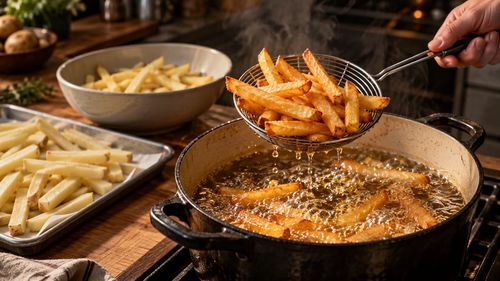
For deep frying, the thermometer is the difference between properly fried food and food that is either undercooked or oil-saturated from insufficient heat — the problem discussed at length in the context of why home frying rarely matches restaurant results.
For bread baking, the thermometer removes the uncertainty from the moment of doneness. A loaf of bread that reads 200 to 210°F at its center is done, regardless of how the crust looks or how hollow it sounds when tapped — two indicators that are useful but not definitive in the way that temperature is.
For custards, sauces, and anything temperature-sensitive, the thermometer is the tool that catches the moment before overcooked — the moment at which a crème anglaise is perfectly set and still fluid, rather than the moment after, when the eggs have scrambled and the sauce is broken.
The Spider: The Tool for Everything That Lives in Hot Liquid
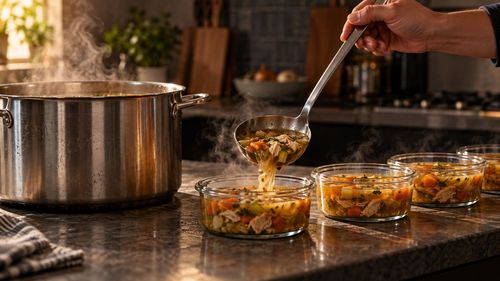
The spider — a wide, shallow wire-mesh basket on a long handle — is the professional kitchen’s essential tool for moving food through hot liquids and into plates or containers without bringing the liquid along.
It retrieves blanched vegetables from boiling water without draining the pot. It lifts fried food from oil and holds it briefly over the cooking vessel to drain before placing it on a rack. It removes pasta from boiling water to a waiting pan of sauce — the professional technique that preserves both the pasta cooking water and the pasta’s temperature more effectively than draining through a colander.
The spider accomplishes all of this more gently and more precisely than tongs, which grip and can damage delicate ingredients, and more efficiently than a slotted spoon, which is too small for most tasks and requires multiple passes where a spider requires one.
It is particularly valuable for blanching — the technique of briefly cooking vegetables in boiling water and immediately transferring them to ice water to stop the cooking and preserve color and texture. With a spider, multiple batches can be blanched in the same pot of boiling water without draining and refilling, which is how professional kitchens maintain the efficiency that blanching in volume requires.
A spider costs between ten and twenty dollars and takes up minimal drawer space. In a kitchen that cooks regularly, it earns its place quickly.
The Takeaway
The tools that make the most difference in daily cooking are rarely the most expensive or the most discussed. They are the ones that solve specific problems so efficiently — the bench scraper that moves ingredients, the scale that produces consistency, the Microplane that adds aromatic intensity, the thermometer that removes guesswork, the spider that handles hot liquids — that their absence becomes noticeable the moment they’ve been used.
None of these cost more than thirty dollars. All of them are present in professional kitchens because professional kitchens cannot afford the inefficiency of working without them.
Home kitchens, it turns out, can’t afford it either.
They just haven’t always known what they were missing.