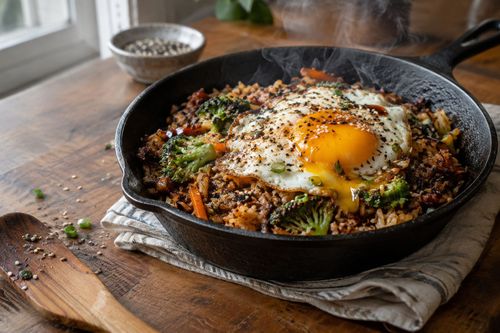

There is a kind of cooking knowledge that doesn’t live in any book.
It doesn’t have an ISBN or a beautiful cover photograph or a foreword by a celebrated chef. It can’t be ordered online or found in the cookbook section of any bookstore. It wasn’t developed in a test kitchen or refined over multiple editions or styled for a photography shoot.
It lives in the specific knowledge of what to do with too many zucchini. In the understanding of what happens when you have a quart of cherry tomatoes that are starting to go soft. In the instinct that says the peaches on the counter are at exactly the right moment of ripeness and must be dealt with now, today, before the moment passes.
This is the summer cookbook that no one wrote — the collection of techniques and approaches and improvisational moves that the cook with a summer garden or a farmers market habit or simply an abundance of seasonal produce develops, over years, in response to the specific challenge of having more good things than can be eaten immediately.
It is one of the most practical bodies of cooking knowledge available. And it is learned almost entirely through experience rather than instruction.
The Zucchini Problem and Its Solutions
Every summer, at some point, there is too much zucchini.
This is such a consistent feature of summer vegetable gardening that it has become a cultural joke — the neighbor who leaves bags of zucchini on doorsteps, the community board post offering free zucchini to anyone who will take them, the resigned acknowledgment that the zucchini plant, once established, produces with an indifference to human capacity to consume it that borders on aggressive.
The cook confronted with too much zucchini has a specific and practically useful set of options.
Zucchini bread — the quick bread made with grated zucchini folded into a spiced batter — is the most common response and, for the cook who hasn’t encountered it before, a genuine surprise. The zucchini does not make the bread taste like zucchini. It makes the bread moist, tender, with a crumb that stays fresh for days. It is a vehicle for using significant quantities of zucchini in a preparation that produces something reliably delicious that most people will eat without needing to be told it contains a vegetable they might otherwise decline.
Zucchini fritters — grated, salted to draw out the moisture, squeezed thoroughly dry, combined with egg and flour and cheese and herbs, fried until crisp — are one of the most satisfying uses of summer squash in abundance. The salting and drying step is essential and is the step most often skipped, which is why many home versions produce a soggy fritter rather than the crisp, griddled cake that the technique is capable of.
Zucchini soup — made by sautéing zucchini with onion and garlic, simmering in stock until very tender, and blending until completely smooth — produces a soup of surprising depth and creaminess that uses enormous quantities of zucchini in a single preparation and that can be served hot or cold, depending on the temperature of the evening.
And zucchini preserved in olive oil — blanched briefly, dried thoroughly, packed into jars with garlic and herbs and covered completely with olive oil — is a preserved product that holds for weeks in the refrigerator and produces, from a vegetable that is mild and somewhat neutral in flavor, something that has taken on the character of the oil and the herbs and has a concentrated sweetness from the blanching that fresh zucchini doesn’t have.
The Tomato at the Edge of Its Life
The peak-season tomato that has spent a day too long on the counter — that is at the moment just past its ideal raw state, soft and slightly collapsing, no longer the firm, juicy thing it was yesterday — is not a failed tomato. It is a tomato that has arrived at its highest culinary purpose.
The slightly overripe tomato is the tomato most suited to cooking — because its cell walls have already broken down, because its water content has already begun to concentrate, because the cooking process will accelerate and complete the concentration that was already underway. The same qualities that make it less pleasant to slice raw make it the best possible candidate for sauce, for roasting, for the slow oven transformation that turns soft, slightly damaged tomatoes into something sweet and concentrated and extraordinary.
The overnight roasted tomato — the tomatoes halved, tossed with olive oil and salt, placed cut-side up in a low oven (around 300°F) for three to four hours until they have collapsed and concentrated and their liquid has evaporated into the flesh — is perhaps the highest use of the tomato that is past its raw prime. What emerges from the oven is something that tastes more intensely of tomato than anything fresh — a concentrated, slightly sweet, deeply savory ingredient that can be used immediately in a pasta or on toast or alongside cheese, or stored in olive oil in the refrigerator for a week, or frozen for the winter.
The pan sauce made from soft tomatoes — cooked briefly with garlic and olive oil and basil until completely collapsed, seasoned generously, and left with some texture — is a sauce that cannot be made from the firm tomato purchased for slicing. The softness that disqualifies it for the caprese is exactly what makes it ideal for the fifteen-minute pasta sauce.
The Stone Fruit at Its Peak and What to Do With It
The peach or nectarine or plum that has reached the specific softness that indicates it is at its absolute peak has a window measured in hours rather than days — a window in which it is the most perfect version of itself and after which it will be past that perfection.
The cook who notices this window and acts on it has access to preparations that the cook who acts after the window has already produced something different.
The raw peach at its peak needs nothing. This is the first preparation — the one that requires no cooking and no recipe, only the willingness to eat the peach as it is, over the sink if necessary, with the juice running down the forearm in the way that only a genuinely ripe peach can do.
But when there are more peaches than can be eaten immediately — when the farmers market visit or the tree in the backyard has produced an abundance that threatens to pass its peak before it can be consumed — the cook must act quickly and specifically.
The stone fruit that is macerated in a small amount of sugar and a splash of something acidic or alcoholic — a squeeze of lemon juice, a splash of wine or brandy — concentrates its flavor and extends its useful life. The sugar draws out the juice, which combines with the sugar to form a syrup that carries the fruit’s flavor more intensely than the fruit alone. Macerated peaches served over ice cream or yogurt or simply in their own syrup with a piece of bread are one of the essential preparations of peak summer.
The galette — the free-form, single-crust pastry that requires no pie dish and no crimping skill and that accommodates stone fruit in any state from barely ripe to just past peak — is the fastest path from abundance to dessert. The pastry is made, the fruit is sliced and tossed with sugar and a small amount of starch, the pastry is formed around the fruit and baked until golden. The entire preparation takes thirty minutes of active time. The result is one of the most impressive and most satisfying summer desserts available.
The Herb Before It Bolts
Every summer herb has a moment when it signals its intention to flower and go to seed — to bolt, in the gardening term, which redirects the plant’s energy from producing leaves to producing flowers and seeds and reduces the flavor of the remaining leaves in the process.
The basil that is just beginning to push up flower stalks. The cilantro that has developed the lacy flowers that signal the end of its leaf production. The dill that has sent up its umbel of yellow flowers.
Each of these moments is a signal to the cook: use this now, before the plant redirects its energy and the flavor of what remains diminishes.
The basil that is about to bolt is the best basil for pesto — because the plant has reached the maximum concentration of the essential oils that produce basil flavor, at the peak before the energy is redirected away from the leaves. A batch of pesto made from this basil — frozen in portions, covered in olive oil to prevent oxidation — carries the specific intensity of peak-season basil into the winter months in a way that store-bought basil, grown in greenhouse conditions and harvested before it has developed its full flavor, cannot provide.
The cilantro at the edge of bolting can be used completely — the tender stems and developing flower buds have a flavor that is similar to the leaves but slightly more complex, useful in preparations where the herb is used generously. The seeds that follow the flowers, if the plant is allowed to finish its cycle, are coriander — a different ingredient entirely, with a different flavor profile, worth collecting and drying if the plant is in a position where it can finish naturally.
The Berry That Must Be Used Today
Of all the summer produce with the narrowest window of peak quality, berries are the most urgent. The raspberry that was perfect this morning may be past perfect by evening. The strawberry that was at its peak on Friday will be noticeably less vivid by Sunday. The blueberry holds better but still has a specific moment of peak flavor that a few days of refrigeration diminishes.
The cook with more berries than can be eaten immediately has several options, each with a different outcome and a different practical consideration.
The quick jam — not the full preserve that requires sterilization and proper canning technique, but the refrigerator jam made from berries and sugar and a small amount of lemon juice, cooked briefly and stored in the refrigerator for up to three weeks — is the fastest and most flexible berry preservation available. It concentrates the berry flavor, extends the useful life significantly, and produces something that is genuinely better on toast than the commercial jam it replaces.
The berry shrub — the drinking vinegar made from berries, sugar, and good vinegar, macerated together and strained — is one of the most interesting uses of berry abundance, producing a concentrated syrup with a specific sweet-sour character that diluted with sparkling water makes one of the most refreshing summer drinks available. The acid in the vinegar preserves the berry flavor and extends the shelf life of the shrub for months in the refrigerator.
And the frozen berry — spread on a sheet pan in a single layer to freeze individually before being packed into a container — is the simplest preservation of all, requiring no cooking and no technique, producing berries that can be used through the winter in smoothies, in baked goods, in sauces, and in any preparation where the specific fresh texture of the berry is less important than its flavor.
The Takeaway
The summer cookbook that no one wrote is the one being written in real time by every cook who encounters an abundance of peak-season produce and figures out what to do with it before the moment passes.
It contains the zucchini fritter and the overnight roasted tomato and the peach galette and the basil pesto and the berry shrub. It contains the specific knowledge of when something is at its peak and what to do at that exact moment, and the different knowledge of what to do when that moment has just passed.
It is learned through seasons of paying attention — to what is growing, to what is on the counter, to what must be dealt with today rather than tomorrow.
This knowledge is worth accumulating.
And it starts with noticing what is there, right now, and asking what it most wants to become.