
There is a moment in many home cooking experiences that feels quietly defeating.
You’ve followed the recipe. You’ve done everything right. The sauce looks correct — the right color, the right consistency, the right amount. And then you taste it, and something is missing. It’s fine. It might even be good. But it doesn’t have that depth, that body, that quality that makes a restaurant sauce taste like it took far longer than it did.
It did take longer. Just not in the way you’re thinking.
The difference between a restaurant sauce and a home sauce is rarely the recipe. It’s what’s underneath the recipe — a foundation that professional kitchens build continuously, maintain carefully, and treat as the single most important preparation in the entire kitchen.
The Foundation That Professional Kitchens Never Skip
In a serious restaurant kitchen, the stockpot is almost never cold.
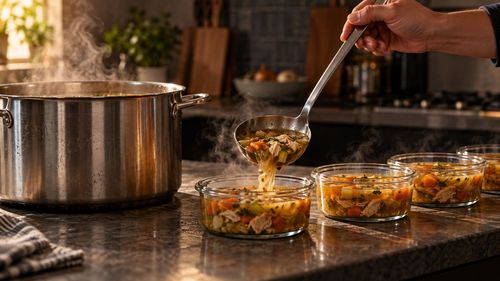
Stock — made from roasted bones, aromatics, and time — is the liquid foundation of virtually every sauce, braise, soup, and pan reduction that leaves a professional kitchen. It’s not an ingredient that gets pulled from a shelf when a recipe calls for it. It’s a living preparation that gets made in large batches, used constantly, and replenished as a matter of daily routine.
What makes housemade stock irreplaceable is what commercial stock cannot replicate: gelatin. When bones — particularly collagen-rich ones like chicken feet, veal knuckles, or beef marrow bones — are simmered low and slow for hours, the collagen breaks down into gelatin, which dissolves into the liquid and gives it a body and richness that no carton or cube can provide.
A sauce made with proper stock reduces into something glossy and cohesive, with a texture that coats the back of a spoon and clings to food. A sauce made with commercial stock reduces into something thinner, flatter, and structurally different — because the gelatin isn’t there to give it body.
This is the foundation. Everything built on top of it inherits its quality — or its absence.
Roasting First Changes Everything
The bones going into a professional stock are almost never raw. They’re roasted.
Spreading bones across a sheet pan and roasting them at high heat until they’re deeply browned — not just colored, but genuinely dark, with caramelized surfaces and rendered marrow — before they ever go into the stockpot produces a fundamentally different result than starting with raw bones.
The Maillard reaction that occurs during roasting produces hundreds of flavor compounds that transfer directly into the stock as it simmers. The fat and marrow that render out during roasting add richness. The deep brown color of the finished stock — compared to the pale, anemic color of a stock made from unroasted bones — is a visual signal of the flavor difference underneath.
The vegetables go into the oven too, in many professional kitchens — onions, carrots, and celery halved and charred until deeply colored before they join the bones in the pot. A halved onion placed cut-side down directly on a dry burner flame until blackened is a technique that adds a smoky, caramelized depth to stock that shortcuts simply cannot replicate.
Most home cooks who make stock at all skip the roasting step. The stock they produce is lighter in every sense of the word.
The Simmer That Never Boils
Once the roasted bones and vegetables are in the pot and covered with cold water, the single most important variable in stock making is temperature — and professional kitchens are almost obsessive about it.
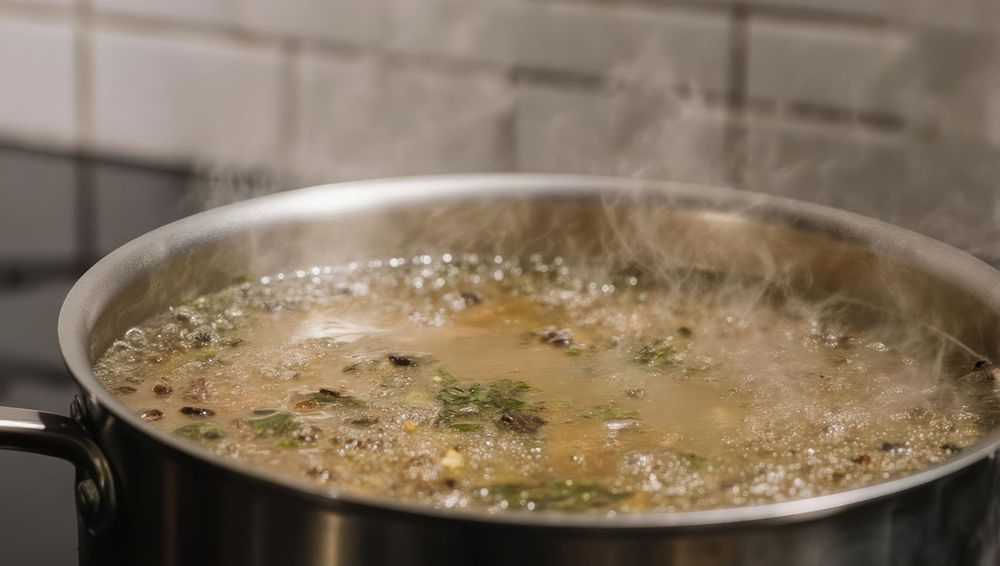
Stock should never boil. It should simmer — barely, with just the occasional bubble breaking the surface — for the entire duration of its cooking time. The difference between a stock that simmers and one that boils is not a matter of speed. It’s a matter of clarity and flavor.
A boiling stock agitates the liquid violently, which emulsifies fat and impurities into the liquid rather than allowing them to rise to the surface and be skimmed. The result is a cloudy, greasy stock with a muddy flavor. A stock held at a gentle simmer allows impurities to rise slowly to the surface — where they can be skimmed away — and produces a clear, clean liquid with a clean flavor.
Professional cooks skim their stocks regularly throughout the cooking process. The grey foam that rises in the first thirty minutes of simmering is impurities leaving the bones — and removing it produces a cleaner, more refined final stock. Home cooks who walk away and return hours later find that everything that should have been skimmed has boiled back into the liquid.
Patience and attention, applied over hours, are the techniques here. There is no shortcut that replicates them.
What Happens After the Stock Is Made
Stock by itself is not a sauce. It’s the beginning of one. What professional kitchens do with their stock — the reductions, the additions, the finishing techniques — is where the sauce work actually begins.
Reduction is the primary tool. Stock simmered down to a fraction of its original volume concentrates its gelatin, its flavor, and its body into something progressively richer and more intense. A stock reduced by half becomes a demi-glace. Reduced further still, it becomes a glace de viande — a thick, intensely flavored syrup that a professional cook might add by the spoonful to a pan sauce to give it immediate depth and body.
Pan sauces in professional kitchens are built on this foundation. After a protein is seared and removed from the pan, the fond — the caramelized proteins and sugars stuck to the pan surface — gets deglazed with wine or another acid. Stock goes in. The whole thing reduces rapidly over high heat, picking up everything in the pan. Cold butter gets mounted in at the end for gloss and richness.
The entire process takes five minutes. The depth of flavor it produces took hours to build — in the stockpot, before the sauce pan was ever touched.
The Shortcut That Actually Works
Not every home cook will commit to making stock from scratch on a regular basis. Professional kitchens understand this reality in the context of their home cooking too — many chefs freely admit that they keep good quality store-bought stock in their home refrigerators for weeknight cooking.
The distinction is in how they use it.
A professional cook working with store-bought stock treats it as a starting point rather than a finished ingredient. They reduce it before using it in a sauce — simmering it down by a third to a half to concentrate whatever flavor it has and drive off excess water. They supplement it with aromatics, with wine, with the fond from whatever protein they’ve just cooked. They build on top of it rather than simply pouring it in.
The store-bought stock that goes into a pan sauce in a professional home kitchen comes out tasting significantly different from the same stock used straight from the carton — because it’s been treated as a foundation to be developed, not a liquid to be added.
That distinction is available to every home cook. It just requires knowing it exists.
The Takeaway
Great sauces are not made in the sauce pan. They’re made in the stockpot, hours or days before service, by cooks who understand that the depth and body of a finished sauce can only be as good as the liquid it was built from.
Start with roasted bones. Simmer without boiling. Skim with patience. Reduce with intention. And if the stockpot isn’t happening on a given weeknight, treat the store-bought version as a starting point rather than a finished ingredient.
The sauce on the plate is the last five minutes of a process that began much earlier. Understanding that changes how every sauce gets made.