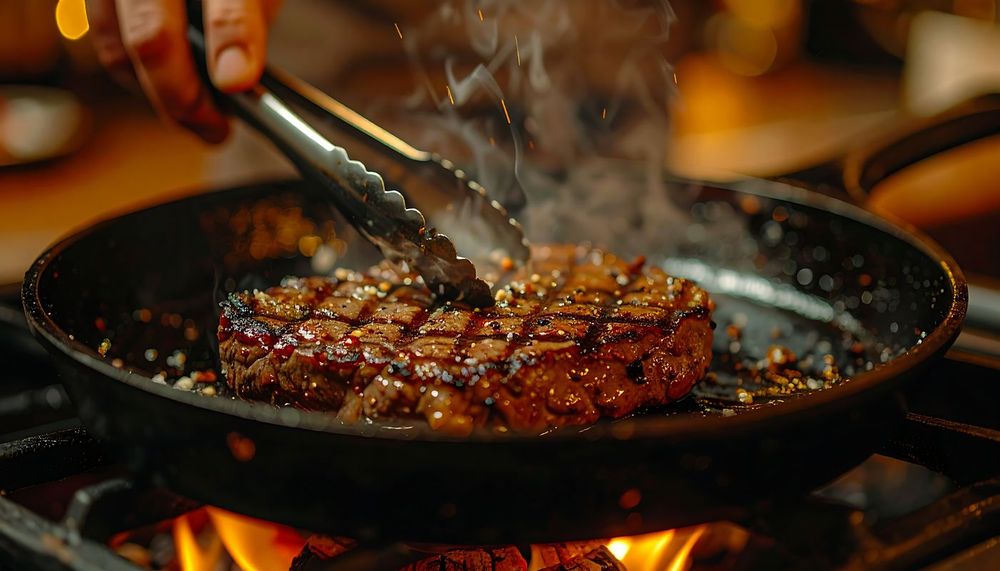

You want a perfect sear.
That deep brown crust. The caramelized exterior that adds flavor and texture. The kind of sear you see on restaurant steaks and chops.
So you heat your pan, add your meat, and wait.
But instead of browning, the meat just sits there. It steams. It turns gray. Liquid pools around it.
You turn up the heat, hoping that fixes it. Sometimes it burns on the outside while staying undercooked inside. Sometimes it just never develops that crust at all.
The problem isn’t your technique. It’s what you did—or didn’t do—before the meat ever hit the pan.
Wet Meat Won’t Sear
Moisture is the enemy of browning.
When meat is wet—either from its packaging, from rinsing, or from being insufficiently dried—that surface moisture has to evaporate before any browning can happen.
While the meat sits in the pan, it’s essentially steaming itself. The temperature never gets high enough for the Maillard reaction—the chemical process that creates a brown crust and all those complex, savory flavors.
Chefs obsessively dry meat before it goes anywhere near a hot pan.
Paper towels. Pat it down. Get every surface as dry as possible.
It seems minor, but it’s the difference between meat that sears immediately and meat that sits in its own steam for two minutes before it even starts to brown.
Crowding the Pan Drops the Temperature
You have six chicken breasts to cook. You put all six in the pan at once because it’s faster.
Except it’s not.
Every piece of cold meat you add to the pan pulls heat away from the cooking surface. Add too much at once and the temperature drops so dramatically that nothing browns—everything just simmers in the moisture it releases.
Restaurants cook in batches. They’ll sear two steaks at a time in a large pan rather than cramming in four.
The pan stays hot. Each piece browns properly. It takes a little longer overall, but the results are incomparably better.
If your pan can’t maintain its temperature when you add the meat, you’ve added too much.
The Meat Is Too Cold
Straight from the refrigerator to the pan seems efficient.
But ice-cold meat cools the pan even more than room-temperature meat does. And the inside of the meat is so cold that by the time the center cooks through, the outside is overdone.
Chefs bring meat to room temperature before cooking.
Not warm. Not hot. Just not refrigerator-cold.
Thirty minutes on the counter for steaks or chops. An hour for a large roast.
This ensures more even cooking and helps the pan maintain its temperature when the meat hits the surface.
You’re Moving It Too Soon
You put the meat in the pan and immediately start poking it. Flipping it. Checking if it’s ready to turn.
Every time you lift the meat, you break the contact with the hot surface. The sear doesn’t develop properly because the meat isn’t staying put long enough.
Chefs put meat down and don’t touch it.
They let it sit undisturbed until a proper crust forms. The meat will naturally release from the pan when it’s ready—forcing it early just tears the surface and prevents browning.
This requires patience. Resist the urge to fiddle with it. Let the pan do its work.
The Pan Isn’t Hot Enough
Medium heat might work for vegetables. It doesn’t work for searing meat.
The pan needs to be hot—legitimately hot—before the meat goes in. Hot enough that you hear an aggressive sizzle the moment meat makes contact.
If you don’t hear that sound, the pan isn’t ready.
Chefs preheat their pans for several minutes. They test with a drop of water to make sure the surface is at the right temperature.
Then—and only then—do they add the meat.
Putting meat in a pan that’s only moderately warm guarantees poor results. The meat never gets hot enough to brown properly.
You’re Using the Wrong Pan
Thin, lightweight pans lose heat the moment you add cold meat to them.
Even if they start hot, they can’t maintain that temperature once meat goes in. The sear stalls. The meat cooks unevenly.
Heavy pans—cast iron, thick stainless steel, carbon steel—hold heat better. They recover faster when something cold hits the surface.
That thermal mass is what allows restaurants to get consistent sears. The pan stays hot enough to actually brown the meat instead of just warming it.
If you’re working with thin pans, you have to compensate by using higher heat and cooking in smaller batches. Even then, the results won’t be as good.
There’s Not Enough Fat in the Pan
A bare pan—even a hot one—won’t give you an even sear.
You need a thin layer of fat to create consistent contact between the meat and the hot surface. Fat conducts heat better than air does.
Chefs use just enough oil to coat the bottom of the pan. Not a pool. Not a dry surface. Just a thin, even layer.
This also prevents sticking and helps the crust develop uniformly across the entire surface of the meat.
Too little fat and you get patchy browning. Too much and the meat practically fries instead of searing.
Seasoning Happens Right Before Cooking
Some people season meat hours ahead. Some don’t season until after it’s cooked.
For a good sear, seasoning should happen right before the meat hits the pan.
Salt draws moisture to the surface. If you salt too early, that moisture has time to pool—and then you’re back to the problem of trying to sear wet meat.
Season immediately before cooking and the salt enhances flavor without creating surface moisture that interferes with browning.
This is especially important for steaks and chops. Less critical for slow-cooked braises, but essential for anything where crust matters.
You’re Flipping Too Many Times
Some cooking methods benefit from frequent flipping. Searing isn’t one of them.
You want to develop a crust on one side, then flip once and develop a crust on the other.
Constant flipping prevents either side from staying in contact with the pan long enough to actually brown.
Chefs flip meat once. Maybe twice for very thick cuts. That’s it.
Each flip interrupts the Maillard reaction. The more you interrupt it, the worse your sear becomes.
Put the meat down. Leave it alone. Flip it when it’s ready. Leave it alone again. Done.
The Meat Hasn’t Been Scored or Flattened
Meat that’s uneven in thickness cooks unevenly.
Thick parts are raw when thin parts are overdone. And uneven surfaces don’t make full contact with the pan, which means inconsistent browning.
Chefs pound chicken breasts to even thickness. They score thick cuts to help them lay flat. They butterfly thick steaks so both sides sear properly.
This isn’t just about presentation. It’s about ensuring even contact with the cooking surface so you get uniform browning.
Patience Isn’t Optional
Searing requires restraint.
Don’t touch the meat. Don’t lower the heat. Don’t add more pieces than the pan can handle. Don’t rush.
Every shortcut you take undermines the process.
Restaurants get perfect sears because they follow the steps every single time. Hot pan. Dry meat. Room temperature. Don’t crowd. Don’t move.
Home cooks skip one or more of these steps, then wonder why their results are inconsistent.
But there’s no mystery. Searing has rules. Follow them and it works. Skip them and it doesn’t.
What You Should Do Next Time
Take your meat out of the fridge thirty minutes before cooking. Pat it completely dry with paper towels. Season it right before it goes in the pan.
Heat your pan until it’s properly hot—test it with water droplets if you need to. Add a thin layer of oil.
Place the meat in the pan and don’t touch it. Let it sit undisturbed until a crust forms and it releases naturally.
Flip once. Let it finish. Remove it from the pan.
That’s the technique. That’s what works.
The Takeaway
A perfect sear isn’t luck. It’s not about having the most expensive pan or cooking on a professional range.
It’s about understanding what prevents browning and eliminating those obstacles.
Dry meat. Hot pan. Room temperature. No crowding. No moving.
Every one of those factors matters. Miss even one and the sear suffers.
Chefs don’t get better results because they’re more skilled. They get better results because they don’t skip steps.
And neither should you.
Because once you understand what actually creates a sear—and what prevents it—you’ll never struggle with this again.