
Archaeologists excavating ancient Egyptian tombs have found jars of honey thousands of years old — still perfectly edible, still recognizably honey. No refrigeration. No preservatives. Just time, and lots of it.
Almost nothing else in a kitchen can make that claim. Understanding why honey pulls this off says a lot about what actually causes food to spoil in the first place.
The Two Things Bacteria Need to Survive
Spoilage almost always comes down to microorganisms — bacteria, mold, yeast — finding a hospitable place to grow. Two things those organisms need most are moisture and a lack of acidity.
Honey fails both requirements dramatically. It's low in moisture and highly acidic, creating an environment that's actively hostile to the microbes responsible for spoiling most other food.
Bacteria essentially can't get a foothold, which is most of the reason honey doesn't need a preservation method at all.
Why Moisture Is the Bigger Story
Honey is a supersaturated sugar solution, meaning it holds more dissolved sugar than water can normally support at that concentration.
That imbalance pulls moisture out of anything it touches, including bacteria and mold spores. Through a process called osmosis, water gets drawn out of microbial cells until they dehydrate and die, unable to survive in an environment actively stealing their moisture away.
It's less that honey resists bacteria, and more that bacteria can't survive inside it long enough to become a problem.
What Bees Actually Do to Make This Possible
Raw nectar collected by bees starts out far too watery to have these properties. Getting it to honey's final state takes real biological engineering.
Bees repeatedly regurgitate and process nectar, adding an enzyme that starts breaking down complex sugars. They then fan the mixture with their wings inside the hive, evaporating most of the remaining water content until it reaches honey's low-moisture final form.
That enzyme also produces a small amount of hydrogen peroxide as a byproduct, adding another layer of antimicrobial protection on top of the sugar and acidity already at work.
Why Honey Sometimes Looks "Expired" Even Though It Isn't
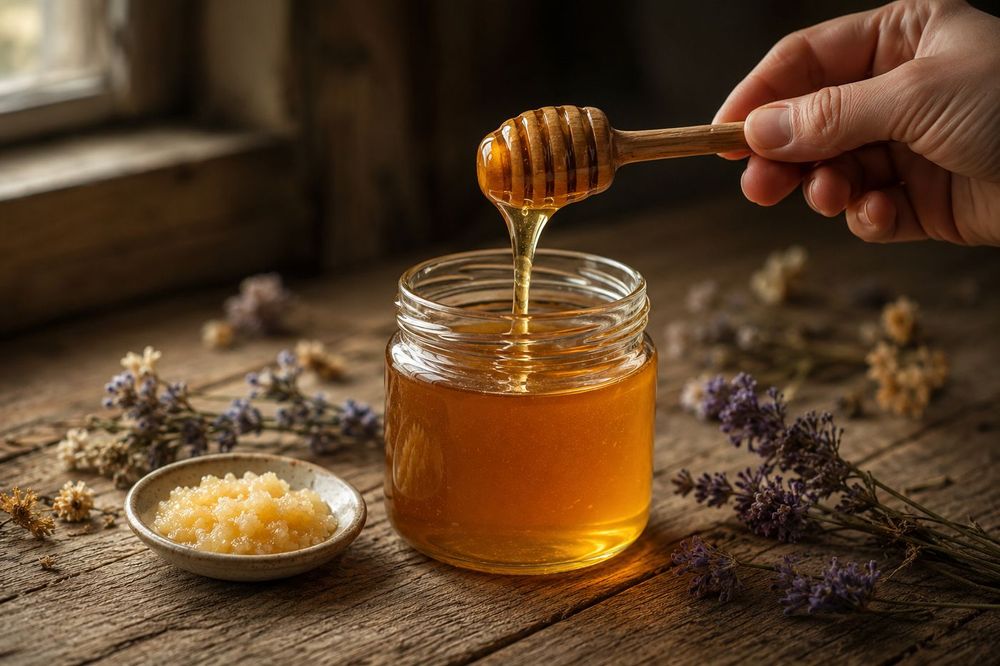
A jar of honey that's turned cloudy, grainy, or solid looks like it's gone bad. It almost certainly hasn't.
That process is crystallization, a natural result of honey's sugar content separating out over time, especially in cooler temperatures. It's a texture change, not a safety issue, and it's easily reversed by gently warming the jar in warm water until it returns to liquid form.
Raw, unfiltered honey crystallizes faster than heavily processed honey, which is part of why crystallization is sometimes mistaken as a sign of lower quality when it's often closer to the opposite.
The One Real Way Honey Can Actually Go Bad
Honey's near-immortality has one meaningful exception: contamination with water.
Using a wet spoon, storing it somewhere humid, or leaving the lid off for extended periods can introduce enough moisture to disrupt the low-water environment that keeps microbes out. Once that balance shifts, fermentation or mold growth becomes possible, something that essentially never happens in properly sealed, dry honey.
A clean, dry utensil and a tightly sealed container are really the only maintenance honey ever needs.
The Takeaway
Honey doesn't survive for thousands of years by accident. It survives because of a precise chemical environment — built by bees, refined over millions of years of evolution — that happens to be lethal to almost everything that causes food to spoil.
That jar sitting in the back of the pantry, slightly cloudy and half-crystallized, isn't past its prime. It might be exactly as good as the day it was made.
Few things in a kitchen come with a shelf life measured in millennia. Honey quietly does.