
Most home cooks own a knife. Many own several.
And most of them are using those knives in ways that make cooking harder, slower, and less precise than it needs to be — without knowing it. The knife feels fine. The food gets cut. Dinner happens. Nothing about the experience announces that something is wrong.
But spend an afternoon in a professional kitchen and the difference becomes immediately visible. A line cook moves through prep with a speed and confidence that looks almost casual. The cuts are consistent. The knife doesn’t slip. Nothing gets crushed when it should be sliced. The whole process looks effortless in a way that has nothing to do with natural talent and everything to do with a handful of deeply ingrained habits.
Those habits are learnable. Most home cooks just haven’t been shown them.
A Dull Knife Is the Most Dangerous Tool in Your Kitchen
This is not a metaphor. A dull knife requires significantly more force to cut through food than a sharp one, and more force means less control. The knife is more likely to slip off a curved surface, skid across a tomato skin, or catch on a carrot and redirect unpredictably toward a finger.
Professional cooks work with sharp knives — not occasionally sharpened, not sharp enough for most things, but genuinely, consistently sharp. A sharp knife moves through food with a level of ease and precision that feels almost frictionless. It doesn’t require force. It requires direction.
The distinction between honing and sharpening is one that most home cooks are unaware of, and it matters. A honing steel — the long rod that often comes with knife sets — doesn’t sharpen a blade. It realigns the edge of the blade, which rolls slightly out of true with regular use. Honing should happen every time a knife is used. Sharpening, which actually removes metal to create a new edge, needs to happen far less frequently — but it does need to happen.
Professional cooks hone before every service. Their knives go to a whetstone or a professional sharpener when the honing stops making a difference. Home cooks who adopt this habit alone will notice an immediate and significant difference in how their knife feels and performs.
The Grip Is Probably Wrong
There is a grip that professional cooks use almost universally — and it is not the grip most home cooks have taught themselves.
Most home cooks hold a knife by wrapping all four fingers around the handle, with the thumb on the side of the handle or tucked behind the fingers. This grip feels natural and secure. It also places the index finger far from the blade, reducing control significantly.
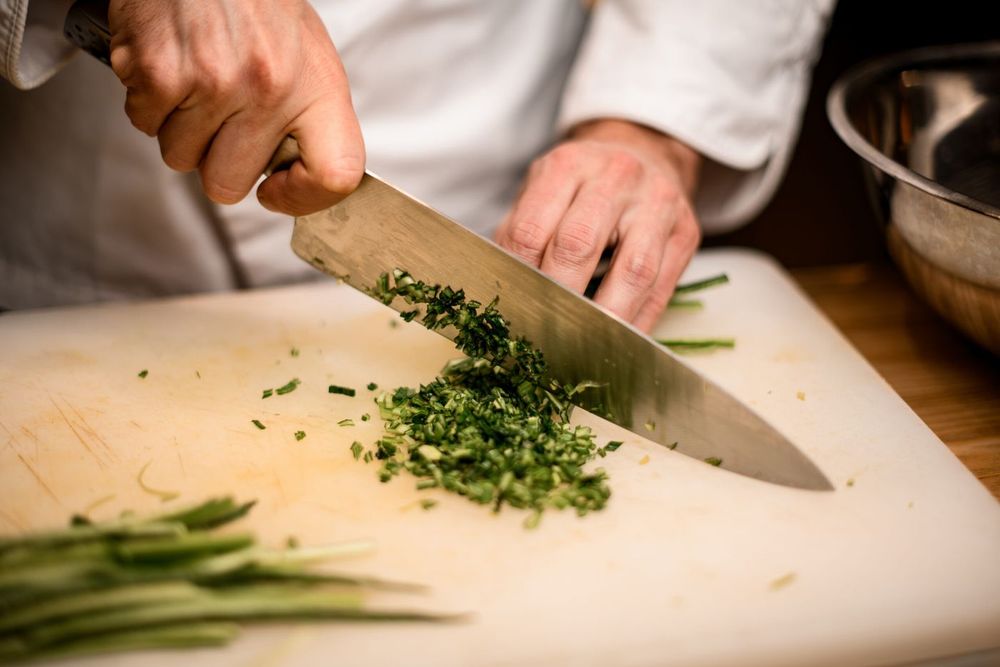
The professional grip — called the pinch grip — involves pinching the base of the blade itself between the thumb and the bent knuckle of the index finger, with the remaining three fingers wrapped around the handle. The blade is gripped, not just the handle. This positions the hand directly behind the cutting edge, transfers control from the handle to the blade itself, and gives the cook precise authority over every cut.
It feels strange at first. It feels extremely strange if you’ve been holding a knife the other way for twenty years. And then, within a few sessions, it starts to feel more natural than the old grip — because it is more natural, in the sense that it’s actually designed around how cutting works.
The Guide Hand Is Doing Half the Work
The hand that isn’t holding the knife is not passive in professional knife work. It’s an active participant — and how it’s positioned determines both the precision of the cut and the safety of the fingers attached to it.
Professional cooks use what’s called the claw grip on their guide hand: fingertips curled under, knuckles forward, the flat of the blade resting lightly against the knuckles as the knife moves. The knuckles act as a guide for the blade — controlling the width of each slice by moving incrementally backward with each cut. The fingertips are tucked safely behind the knuckles and never at risk.
This grip does two things simultaneously: it protects the fingers and it controls the cut. The knife isn’t measuring the slice — the position of the knuckles is. Once this becomes habitual, consistency in knife work follows almost automatically.
Home cooks who hold the food flat with spread fingers and move the knife with their eyes rather than their guide hand are working much harder than necessary — and taking significantly more risk — for significantly less consistent results.
Consistency in Cuts Is a Cooking Issue, Not Just an Aesthetic One
Professional cooks cut with consistency not because they’ve been told it looks better but because they understand what inconsistent cuts do to food during cooking.
A dice that has pieces ranging from a quarter inch to three-quarters of an inch is not just imprecise — it’s a cooking problem. The small pieces will be done before the large ones have barely started. In a sauté pan, some pieces will be perfectly caramelized while others are still raw in the center. In a soup or braise, the small pieces will have dissolved before the large ones are tender.
Consistent knife work produces consistent cooking results. The two are directly connected. When a restaurant dish tastes even and well-developed throughout, a significant part of the reason is that every piece of every ingredient was cut to the same size and cooked at the same rate.
This is something that practice builds naturally — but only if the cook is paying attention to it as a goal. Chopping quickly without regard to size is not the same practice as chopping deliberately with consistency as the objective.
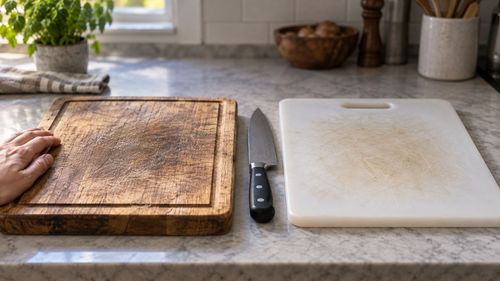
The Cutting Board Matters More Than the Knife
A final habit that professional kitchens are consistent about that home kitchens rarely are: the cutting board needs to be stable, large, and appropriate for the material being cut.
A cutting board that slides around the counter is a safety problem and a precision problem. Professional kitchens place a damp towel under their cutting board — always — so it doesn’t move. This is so fundamental in a professional environment that it happens automatically, without thought. At home, it almost never happens at all.
Board size matters too. A small board forces the cook to work in a cramped space, pushing cut food off the edge to make room for more. A large board — larger than most home cooks think they need — gives room to organize, to push cut ingredients to one side, to work without crowding. Professional prep boards are often enormous by home standards. The space they provide is not luxury. It’s function.
And wood or plastic over glass or ceramic, always. Glass and ceramic cutting boards destroy knife edges faster than almost anything else in the kitchen. The investment in a good knife becomes worthless if it’s being dulled on an inappropriate surface every time it’s used.
The Takeaway
Knife skills are the foundation of everything that happens in a kitchen. Not because precision is a performance — but because a sharp knife, held correctly, guided by a proper claw grip, and used with consistent intention, makes every subsequent step of cooking faster, safer, and more controlled.
The habits are simple. They take time to build. And once they’re built, they change the experience of cooking at a fundamental level — not just the results on the plate, but the feeling of the process itself.
A cook who is comfortable with a knife is a cook who is in control of their kitchen.