
There is something every serious cook develops over time that no cookbook can teach, no culinary school can fully transmit, and no recipe can substitute for.
It doesn’t have a formal name. It gets called intuition, or instinct, or feel. Experienced cooks refer to it as knowing — a quiet certainty about what a dish needs that arrives before the conscious mind has finished forming the question.
It is the most important ingredient in professional cooking. And it is available to every home cook who is willing to build it.
What Culinary Intuition Actually Is
The word intuition implies something mystical — an inexplicable gift that some cooks have and others don’t. The reality is far less romantic and far more accessible.
Culinary intuition is pattern recognition. It is the accumulated result of thousands of repeated observations — the same browning reaction seen enough times to be identified instantly, the same textural change felt often enough to be recognized before it’s visible, the same flavor imbalance tasted so many times that the corrective adjustment arrives as reflex rather than calculation.
A line cook who has seared five hundred pieces of salmon doesn’t think about when to flip it. They know — because the sound, the smell, the slight resistance when the spatula edge is pressed against the flesh have been experienced enough times to encode a specific response. The knowledge is in the hands and the senses, not in the head.
This is not a talent. It is a deposit made over time. And the size of the deposit is determined entirely by the quality of attention brought to each repetition.
The Difference Between Cooking and Practicing Cooking
Most home cooks cook. Fewer practice cooking — and the difference between the two determines how quickly intuition develops.
Cooking means executing a recipe to produce a meal. The goal is the outcome. The process is a means to that end, attended to as much as necessary and no more.
Practicing cooking means attending to the process as a primary object of interest — watching what happens when onions hit a hot pan, noticing the exact moment a sauce shifts from thin to nappe, tasting a dish before and after every adjustment to track the change, cooking the same dish multiple times with small deliberate variations to understand what each variable does.
Professional cooks practice cooking involuntarily — the volume of repetition that a restaurant kitchen demands builds the pattern recognition that becomes intuition whether the cook is consciously developing it or not. Home cooks, cooking a few nights a week, need to be more deliberate about bringing this quality of attention to what they’re doing.
The home cook who makes the same pasta sauce fifteen times, varying the amount of garlic on the third attempt and the cooking time of the tomatoes on the fifth, is building culinary intuition. The home cook who follows a different recipe every night is producing meals but not necessarily developing the deeper understanding that makes cooking feel instinctive.
The Senses Are the Instruments
Culinary intuition is sensory before it is intellectual. It lives in what is heard, seen, smelled, felt, and tasted — and it develops through the deliberate cultivation of sensory attention.
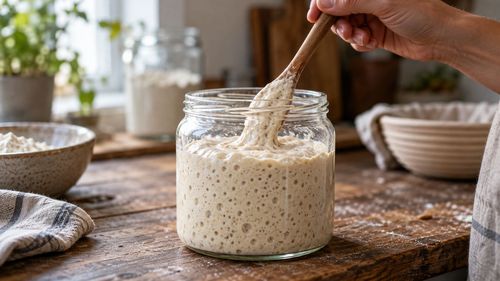
The smell that signals garlic is approaching the edge of burning. The sound that tells a pan it’s properly hot before anything goes in. The feel of a properly proofed dough — alive and resilient in a specific way that under-proofed or over-proofed dough doesn’t replicate. The visual cue of a custard beginning to coat the spoon at exactly the moment it should be pulled from the heat.
Each of these is a sensory signal that carries precise information about what is happening in the cooking — information that arrives faster than a timer, more accurately than a recipe instruction, more specifically than any general description of doneness or readiness can convey.
Professional cooks develop these sensory instruments through repetition. They also develop them through deliberate attention — the habit of noticing and naming what they observe, connecting observation to outcome, and storing the connection as a reference for the next repetition.
A cook who notices that the sauce smells slightly different the moment it’s properly reduced has gained information. A cook who notices, names it, and remembers it has built an instrument.
Tasting Is a Discipline, Not a Pleasure
Of all the sensory practices that build culinary intuition, tasting is the most important — and the one that most home cooks underutilize most consistently.
Tasting in a professional kitchen is not about enjoying the food. It is a disciplined, evaluative practice that happens continuously throughout the cooking process. Before and after every addition. At every stage of development. With a specific question rather than a general sense.
The professional taster is asking: what is this dish now, what does it need, and how will what I add change what it already is? Each taste is a data point. Each data point builds the internal library of references that becomes intuition over time.
Home cooks who taste only at the end — for enjoyment or for a final adjustment — are conducting one evaluation where dozens would build the deeper understanding that makes future cooking more instinctive. The cook who tastes a braise after one hour and after two hours and after three has learned something specific about what time does to that dish. The cook who tastes only when it’s done knows only whether it worked.
Failure Is the Accelerant
There is no faster way to develop culinary intuition than through the careful analysis of failure.
A dish that didn’t work contains more specific, actionable information than a dish that did — because success can be the result of many things, some of which the cook didn’t control, while failure is almost always traceable to something specific that can be understood and corrected.
Professional cooks approach a failed dish analytically. What went wrong, at which stage, and why? Was it a technique failure — something done incorrectly at a specific moment? A sourcing failure — an ingredient that wasn’t at the quality required for the dish? A structural failure — a combination of elements that don’t work together regardless of execution?
The analysis of the failure is itself a practice of intuition-building. It encodes the specific conditions that produced the wrong result and creates the pattern that will be recognized and avoided in future repetitions.
Home cooks who discard failed dishes as evidence that a recipe doesn’t work — rather than examining them as information about what happened and why — are discarding the most valuable learning opportunity cooking produces.
The Recipe Is a Starting Point, Not a Destination
The cook who has developed culinary intuition relates to a recipe entirely differently than the cook who hasn’t.
For the developing cook, a recipe is an instruction set to be followed as accurately as possible. The goal is faithful execution — reproducing the dish as described. Deviation feels like risk.
For the intuitive cook, a recipe is a map of someone else’s thinking about an ingredient or a technique. It is a starting point — a conversation partner — that the cook reads for understanding rather than instruction. The recipe asks: here is how someone has approached this. What do you see in it? What would you do differently? What does it suggest about the ingredient it’s built around?
This relationship with recipes is not achieved by ignoring them. It’s achieved by following them carefully enough, often enough, to understand what they’re actually doing — and then developing the confidence to depart from them when the senses say something different.
The most intuitive cooks are often voracious recipe readers. Not because they follow recipes slavishly, but because they read them as literature — as accumulated thinking about food that they incorporate into a growing internal library.
The Takeaway
Culinary intuition is not a gift. It is an accumulation — built through repetition done with attention, through tasting practiced as discipline, through failure analyzed rather than discarded, and through recipes read as conversation rather than instruction.
It is available to every home cook willing to bring genuine attention to the process of cooking, not just the outcome.
And when it arrives — when the hand reaches for the salt before the mind has finished forming the thought, when the nose lifts from the stove a moment before the timer goes off, when the touch of a spoon against a sauce tells the whole story — it feels like instinct.
It isn’t. It’s practice, accumulated into something that feels like knowing.
And it is, without question, the most important ingredient in the kitchen.