
There is a category of ingredient that occupies a specific and somewhat paradoxical position in contemporary food culture.
It is ancient — some of the grains in this category have been cultivated for thousands of years, predating the wheat varieties that now dominate global agriculture by millennia. It is nutritionally sophisticated — providing protein profiles, fiber content, and micronutrient concentrations that the refined grains of the industrial food system cannot match. It is culinarily versatile — capable of absorbing flavors and adapting to preparations across virtually every culinary tradition.
And it is almost entirely absent from most home kitchens.
The ancient and heritage grains — farro, freekeh, einkorn, emmer, spelt, teff, sorghum, millet, amaranth, buckwheat, and the dozens of regional varieties that exist between these categories — are available in most well-stocked grocery stores and in virtually every natural food market. They cost modestly more than the commodity white rice and refined pasta that dominate the grain category in most home pantries. They require no more skill to cook than any other grain.
And they produce, in terms of flavor, texture, nutritional completeness, and culinary interest, results that the refined grain alternatives cannot approach.
Understanding what these grains are, how to cook them, and what they offer — culinarily and nutritionally — is worth the investment of an afternoon and a few weeks of experimentation in any kitchen that takes food seriously.
Farro: The Roman Grain That Never Left
Of all the ancient grains that have experienced a revival in contemporary food culture, farro is the one that has most completely demonstrated what ancient grains are capable of — both in terms of flavor and in terms of culinary versatility.
Farro is the common name for several species of ancient wheat — primarily Triticum dicoccum, or emmer wheat — that were the primary grain of the ancient Roman world. It fed Roman legions, built Roman civilization, and then was progressively displaced by the higher-yielding wheat varieties that produced the flour that modern baking depends on. In the mountain regions of Tuscany and Umbria, farro never entirely disappeared — it continued to be grown and eaten as a regional specialty even as it faded from mainstream Italian and global agriculture.
Its flavor is the most immediate thing that distinguishes it from the commodity grains it might replace. Farro has a specific nuttiness — a slightly toasted, earthy character that wheat berries hint at but that farro expresses more fully — combined with a sweetness that becomes more pronounced as it cooks. The texture, when properly cooked, is slightly chewy — not the mushy softness of overcooked rice or the dense heaviness of undercooked barley, but a specific, satisfying resistance that means each grain holds its shape and its character through whatever preparation it enters.
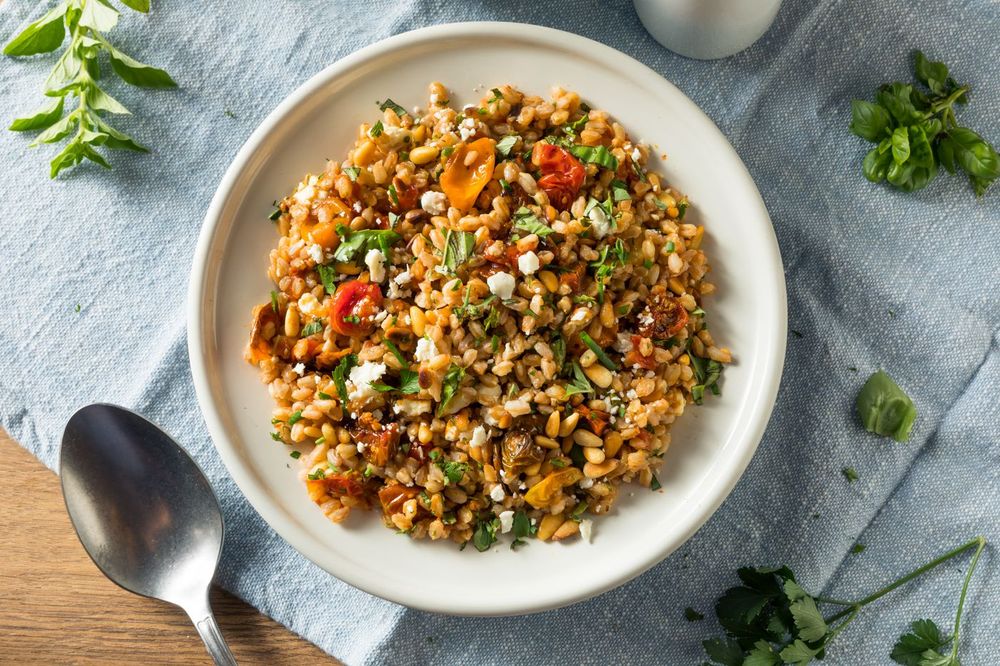
The specific culinary application where farro most clearly demonstrates its superiority to white rice or refined pasta is the grain salad — the preparation where the grain’s individual character is most fully expressed and where the chewiness and the nuttiness are exactly the qualities that make the dish interesting rather than merely filling. A farro salad with roasted vegetables and a sharp vinaigrette, with the grain providing the textural foundation and the flavor backbone, is a preparation that white rice cannot produce regardless of what else is added.
Freekeh: The Green Wheat That Tastes Like Smoke
Freekeh is one of the more dramatic examples of how processing can produce flavor compounds that the raw ingredient doesn’t contain — a demonstration of the principle, familiar from the Maillard reaction and from fermentation, that transformation produces complexity.
Freekeh is durum wheat harvested while still green — before the grain has fully dried on the plant — and then roasted over open fire. The combination of the green grain’s higher moisture content and the intense heat of the roasting produces a specific smoky, slightly grassy, intensely aromatic flavor that no other grain provides. The smoke from the roasting process is literally absorbed into the grain during processing, producing a flavor that survives cooking and that makes freekeh one of the most distinctly flavored grains available.
This flavor — smoky, slightly nutty, with a green, grassy note that reflects the grain’s immaturity at harvest — makes freekeh particularly suited to preparations where a strong grain character is wanted. The Lebanese and Palestinian tradition of cooking freekeh with chicken and spices — the specific combination of cinnamon and allspice and cumin that gives the dish its particular character — produces a preparation where the grain is as much the flavor of the dish as the protein.
Freekeh in a simple pilaf — cooked in good stock with aromatics, finished with herbs and a squeeze of lemon — demonstrates the grain’s specific character more directly and is one of the most immediately rewarding introductions to ancient grain cooking available. The flavor is unusual enough to be interesting and coherent enough to be immediately appealing rather than challenging.
Teff: The Ancient Grain of Ethiopia
Teff — the tiny grain that forms the foundation of Ethiopian cuisine and that has been cultivated in the Ethiopian highlands for thousands of years — is the smallest grain in common use anywhere in the world. Its individual seed is so small that a single teaspoon contains roughly three thousand grains, which is why its name in Amharic reflects this quality: teff means “lost,” as in too small to find if dropped.
Its size produces a specific culinary behavior. Teff cannot be processed the way larger grains are processed — it is too small to have its bran and germ removed without destroying the grain entirely. This means that teff is always consumed as a whole grain, regardless of the form it takes. The flour ground from teff retains all of the nutritional components of the whole grain — the fiber, the protein, the iron and calcium and other minerals that processing removes from other grains.
The flavor of teff is mild and slightly sweet, with a specific earthiness that reflects the grain’s high mineral content. It is most familiar as the primary ingredient in injera — the large, spongy, slightly sour flatbread that is the foundation of Ethiopian eating. The sourness of injera comes from the fermentation that teff undergoes before cooking, which both develops flavor complexity and improves the bioavailability of the grain’s minerals by reducing the phytic acid that would otherwise interfere with absorption.
As a porridge — cooked in water or milk until thick and creamy, seasoned with a small amount of salt and perhaps a drizzle of honey — teff demonstrates what its nutritional profile promises: a grain that is filling, deeply nourishing, and more complex in flavor than its relatively modest culinary profile in Western cooking might suggest.
Millet: The Grain That Grows Anywhere
Millet is not one grain but a category — a loose grouping of several related small-seeded grasses that are grown across Africa, Asia, and parts of Europe and that share certain culinary and nutritional characteristics while differing in flavor and specific nutritional profile.
What unites the millet family is adaptability. Millets are among the most drought-tolerant grain crops available — capable of producing meaningful yields in conditions where more demanding crops fail. They do not require significant irrigation. They grow in poor soils where other grains struggle. They mature quickly, allowing multiple crops per growing season in the right climate. These qualities have made millet the primary grain in many of the world’s driest and least agriculturally productive regions — a survival crop for communities where other options are limited.
In the culinary context of contemporary Western cooking, millet is perhaps the least familiar of the ancient grains worth knowing — and the one whose specific culinary character makes it most worth exploring precisely because of its unfamiliarity.
Millet cooked in the manner of polenta or cornmeal — with excess liquid, stirred continuously until thick, finished with butter and cheese — produces something richer and nuttier than polenta and more interesting than the grain’s relative obscurity in Western cooking suggests it should be. Millet porridge, with the grain cooked until completely soft and creamy, is one of the most comforting grain preparations available and one that adapts to both sweet and savory flavor directions with equal facility.
Amaranth and Buckwheat: The Pseudo-Grains That Behave Like Grains
Amaranth and buckwheat are not technically grains — they are the seeds of broadleaf plants rather than grasses, which makes them “pseudo-cereals” in botanical terminology. In culinary terms, they behave like grains and are used in most of the same applications, which is why they belong in any discussion of grains worth knowing.
Amaranth — the sacred grain of the Aztec civilization, suppressed by Spanish colonizers as a form of cultural control and then gradually recovered over centuries — is a small seed with a flavor that is more intensely earthy and slightly grassy than most true grains. It is particularly high in protein for a grain-category food, and its protein is unusually complete — containing lysine in concentrations that most grains lack and that make amaranth, combined with corn or rice or wheat, a particularly nutritionally complete combination.
Buckwheat — the grain of Russian kasha and Japanese soba and French galettes de sarrasin — has the most distinctive flavor of any grain in common use: intensely nutty, slightly bitter, with an earthy robustness that makes it unmistakable and that either appeals immediately or requires some acclimation to appreciate. Kasha, the roasted whole buckwheat groat that is the foundation of Russian grain cooking, produces a flavor that is more concentrated and more complex than unroasted buckwheat — the roasting developing the Maillard reaction compounds that give it a specific toasted nuttiness on top of buckwheat’s inherent earthiness.
How to Cook Them All
The specific cooking methods for ancient grains vary more than the cooking of commodity white rice — but the variation is logical rather than complex, reflecting the different moisture contents and starch structures of different grains.
The pilaf method — toasting the grain briefly in fat before adding liquid, producing a deeper flavor and a more separated texture in the finished grain — works for most ancient grains and is the method that professional kitchens most consistently use for maximum flavor.
The pasta method — cooking in a large amount of salted boiling water until done, then draining — produces consistent results for farro and wheat berries and other dense grains that benefit from the circulation of boiling water around them.
The absorption method — combining the grain with a specific amount of liquid and cooking until the liquid is absorbed — is appropriate for millet and amaranth and produces a more porridge-like result when excess liquid is used or a more defined texture when the ratio is more precise.
The specific cooking times vary by grain and by age of the grain — older grains absorb more water and take longer to cook than freshly milled ones. Tasting throughout the cooking process and adjusting time based on what the grain actually needs — rather than what the package specifies — is the most reliable approach.
The Takeaway
The ancient and heritage grains are not specialty foods or health food store novelties. They are the grains that human civilization was built on — older, more varied, more nutritionally complete, and in many cases more flavorful than the refined wheat and white rice that displaced them.
Cook them. Start with farro if the flavor spectrum of ancient grains is unfamiliar — its approachable nuttiness and satisfying chew are the most immediately appealing entry point. Explore freekeh for its unique smokiness. Try millet in a savory porridge. Make teff as a morning porridge with honey.
Each new grain is a new flavor and a new set of culinary possibilities — and the pantry that contains several of them is a more interesting pantry than the one that contains only the handful of commodity grains that the industrial food system has reduced our grain choices to.
The grain shelf deserves more variety than it typically gets.
It is worth providing.