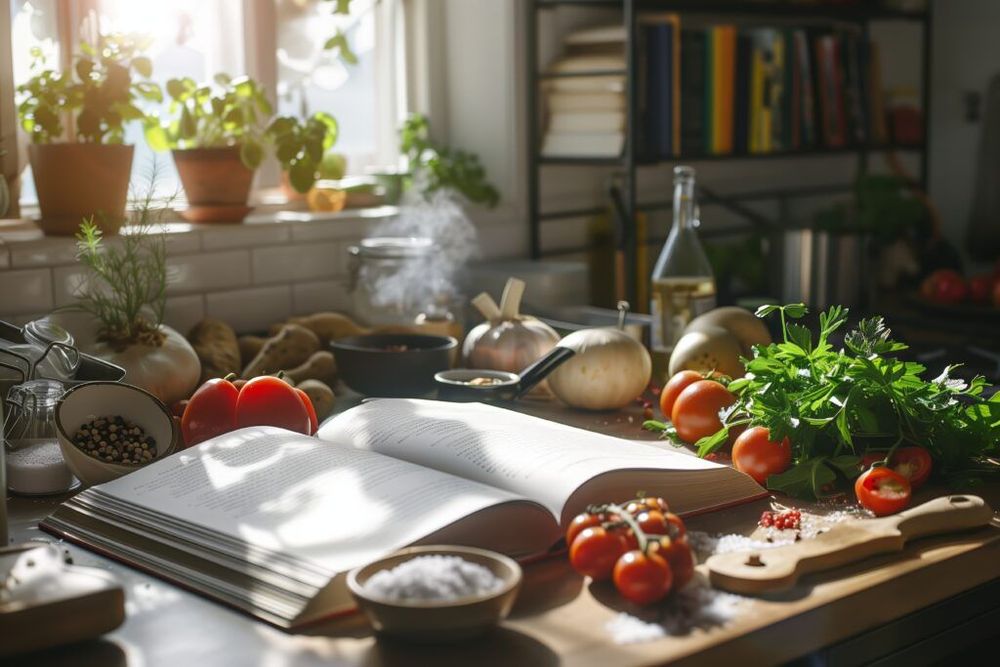

There is a specific quality of reading that belongs to late summer.
Not the ambitious novel that requires sustained attention and a quiet room. Not the dense nonfiction that demands note-taking and rereading. The reading that belongs to late summer is the reading that can be done outside, with a glass of something cold nearby, that can be picked up and set down without losing the thread, that is nourishing rather than demanding.
Food writing — at its best — is exactly this kind of reading.
Not the recipe collection that is consulted rather than read, that lives on the cookbook shelf as a reference rather than as literature. The food writing that is genuinely worth reading in the late summer afternoon — on a porch, by a pool, in the specific light of an August evening — is the writing that treats food as a subject worthy of genuine literary attention and that produces, in the reader who encounters it, a changed relationship with what they cook and eat and think about food.
There is also a more specific and more immediately practical category of late summer food reading: the cookbook that is specifically suited to the season’s ingredients and the season’s cooking, that produces meals from what is on the counter and in the garden and at the farmers market right now, during the weeks when the abundance is at its peak and the cook who has the right book in hand is equipped to use it.
Both categories deserve attention before the season turns.
The Books That Change How You Think
The category of food writing that changes the reader’s relationship with food rather than simply providing recipes has been discussed in these pages before — in the context of the cook’s library and the books that most significantly alter the orientation of the cook who reads them.
In late summer, with the specific abundance of peak-season ingredients immediately available and the specific awareness of the season’s impermanence sharpening the attention, certain books in this category are particularly resonant.
MFK Fisher’s The Art of Eating — the collected volume of her five early books — is the book most specifically suited to late summer reading in a way that is difficult to fully explain without simply recommending it and trusting that the experience of reading it will make the reason clear. Fisher writes about food with a directness and a sensory immediacy that is different from almost any other food writing — she is never abstract about it, never theoretical, always specific in the way that genuinely good food writing is specific. The hunger she describes is always a real hunger, and the food that satisfies it is always specifically itself rather than a representative of a category.
Reading Fisher in August, with the season’s best ingredients immediately available, produces a specific quality of wanting to cook that is different from the general aspiration that food writing more commonly produces. It is a specific wanting — to make the particular thing she is describing, with the particular attention she is bringing to it, in the particular spirit that animates everything she writes about food.
Diana Henry’s A Change of Appetite — a book organized around the specific pleasures of lighter, brighter, more plant-forward eating — is the late summer reading that most directly translates into late summer cooking. Henry writes about food with a warmth and an intelligence that makes every recipe feel personally addressed, and the specific recipes in this book — the grain salads, the vegetable-centered preparations, the light and bright dishes of the summer table — are specifically suited to what is available right now in the peak-season kitchen.
And Tamar Adler’s An Everlasting Meal — the book that is simultaneously a philosophy of cooking and a specific guide to cooking without waste, to using everything, to finding the meal in what is already in the kitchen — is late summer reading that produces a specific and immediate change in how the reader approaches the week’s cooking. Adler’s central argument — that the meal is already in the kitchen, if the cook knows how to look for it — is an argument that is never more applicable than in the abundance of the August kitchen, when the ingredients at their best are everywhere and the cook’s primary task is to see and use rather than to plan and acquire.
The Cookbooks That Work Right Now
Beyond the books that change how the reader thinks, there is the more immediately practical category: the cookbooks that are specifically useful for the ingredients that are in the kitchen right now, in the final weeks of summer abundance.
Plenty by Yotam Ottolenghi — the book that reoriented a generation of home cooks toward vegetables as a primary event rather than a supporting act — is the cookbook most worth having on the counter in August. Its recipes treat the summer vegetables — the eggplant, the tomato, the pepper, the zucchini, the corn — with the specific culinary seriousness that these ingredients deserve at their peak, combining them in ways that are simultaneously unexpected and inevitable, producing dishes that taste specifically of the season in which they are made.
Paula Wolfert’s The Cooking of the Eastern Mediterranean is the book that most completely reveals what the Mediterranean culinary tradition has developed around the summer vegetable — the specific techniques of braising and roasting and preserving that produce dishes of extraordinary depth from the ingredients that August provides in abundance. Wolfert’s recipes are demanding in the way that genuinely excellent recipes are demanding — they require real ingredients treated with real attention — but they produce results that the cook who has made them once wants to make again, and again.
Deborah Madison’s Vegetable Literacy is the book that most specifically equips the late summer cook to understand the ingredients in front of them — not just how to cook them but what they are, how they are related to each other botanically and culinarily, what substitutions are possible and what relationships between ingredients produce the most interesting results. It is simultaneously a cookbook and a reference and a genuinely interesting read — the kind of book that can be opened at any page and engaged with as literature rather than just consulted as instruction.
The Reading That Teaches the Season
There is a category of food writing that is specifically valuable in the late summer weeks — writing that directly engages with the seasonal transition, with the specific moment of abundance and impermanence that August represents.
Eliot Coleman’s The Winter Harvest Handbook — a book ostensibly about extending the growing season into winter through protected cultivation — is valuable in August not for its specific technical content but for the quality of attention it models. Coleman writes about growing food with a specificity and a commitment to quality that is instructive for the cook as much as for the gardener — his insistence on the primacy of the ingredient’s quality, on the importance of freshness and proper timing and the specific conditions that produce excellence, is a philosophy that translates directly from the garden to the kitchen.
And Wendell Berry’s collection of essays — particularly those collected in Bringing It to the Table — provides the most morally serious account of what it means to care about food and about the land that produces it. Reading Berry in August, when the specific abundance of the season is at its most vivid, produces the specific quality of gratitude and attention that the season’s gifts deserve — an awareness that this abundance is not automatic or inevitable but the product of specific people and specific land and specific practices that deserve acknowledgment.
The Recipe Discovery Worth Making Before September
There is a specific and practical late summer reading activity that is worth undertaking deliberately in the weeks before the season turns.
The recipe audit.
The cook who spends an afternoon going through the cookbooks they own — not to cook from them, not to make shopping lists, but simply to read — frequently discovers recipes that use exactly the ingredients that are at their peak right now and that have been overlooked through the season despite being specifically suited to it.
The zucchini fritter recipe that has been marked and not made. The eggplant preparation from the Ottolenghi book that looked too involved in the spring but that now, with peak eggplant immediately available and the late summer afternoon available for a longer cooking session, is exactly right for this week.
This recipe audit — the deliberate reading of existing resources with the specific question of what can be made from what is available right now — is one of the most productive food reading activities available to any home cook. It requires no new books and no new purchases. It requires only the willingness to read what is already owned with the specific attention that the question produces.
The Reading List for the Days After Summer
There is one more category of late summer food reading worth naming — the reading that prepares the cook for what comes after summer, that anticipates the autumn ingredients and the autumn cooking that will replace the summer abundance.
The braising books and the slow cooking books that were set aside in May when the heat of summer made their slow-cooked, oven-intensive content feel inappropriate — these are the books to begin reaching for in the final weeks of August, not to cook from immediately but to read in preparation for the cooking that September and October will invite.
Molly Stevens’ All About Braising. Michael Ruhlman’s Ruhlman’s Twenty. Paula Wolfert’s The Cooking of Southwest France. These are the books that reward slow reading in the final weeks of summer — the books that produce, by the time the first cool evening of September arrives, a cook who is fully prepared for the season that follows and who has been anticipating its specific pleasures through the final weeks of summer’s abundance.
The Summer Food Memory Worth Recording
There is a reading-adjacent activity that belongs specifically to the late summer weeks — one that produces something that future reading will not be able to recreate.
Writing down the summer’s food memories.
Not as a formal food diary or a structured document. As notes — specific, sensory, particular. The tomato that was extraordinary on a specific Tuesday. The meal that was made from what was in the garden and that was better than anything that had been planned. The cookout that produced the conversation that continued after dark. The specific color of the light at the outdoor table in the final weeks of August.
These notes — made now, while the specifics are vivid and the emotional resonance is immediate — are the raw material for the food memory that will persist through the winter and into the following year. They are the record of a summer’s eating life that no photograph fully captures and that no recipe collection preserves.
The cook who makes these notes in late August has something that cannot be purchased or borrowed: the specific record of their own relationship with the season, in their own words, at the moment when the season is still fully present.
The Takeaway
The late summer reading list has two categories — the books that change how the reader thinks about food, and the books that directly support the cooking of the season’s remaining weeks.
Both are worth pursuing before the season turns.
The Fisher and the Adler and the Henry for the thinking. The Ottolenghi and the Wolfert and the Madison for the cooking. The Berry for the gratitude that the abundance deserves. And the recipe audit of what is already owned, approached with the specific question of what can be made from what is available right now.
The books are there.
The August afternoon for reading them is finite.
Use both before the season changes.