
There is a particular kind of creativity that professional kitchens develop out of necessity and that home kitchens almost never cultivate deliberately.
It is not the creativity of the blank slate — the cook who surveys an empty counter and imagines something new from nothing. It is the creativity of the constraint — the cook who looks at what remains from yesterday’s cooking and asks not “what should I make?” but “what is this already becoming?”
The leftover, in most home kitchens, is a diminished thing. A concession to the reality that not everything gets eaten. A container in the refrigerator that represents either tomorrow’s convenience or next week’s guilt, depending on how optimistic the cook was when they put it away.
In a serious kitchen, the leftover is something else entirely.
It is the beginning of the next preparation. The braising liquid that becomes the sauce. The roasted vegetables that become tomorrow’s frittata. The cooked grains that become the base of a bowl, a soup, a croquette. The stale bread that becomes breadcrumbs, croutons, a panzanella, a ribollita.
The cook who thinks in leftovers — who plans the first meal with the second meal already in mind — is the cook who wastes almost nothing and eats exceptionally well in a way that requires significantly less effort per meal than cooking from scratch every night.
The Professional Kitchen’s Approach to Carryover
In a restaurant kitchen, almost nothing is cooked in a quantity precisely calibrated to the expected service. Stocks are made in large batches because the labor required is the same regardless of quantity and the result improves with scale. Braises are started with more meat than a single service will require because the braising liquid — which is the point of the braise — becomes more valuable with more material giving flavor to it. Grains and legumes are cooked in quantity because the cooking time is the same for one portion as for ten.
This approach to batch cooking is not just about efficiency. It is about understanding that certain preparations improve when made in volume, that the labor investment of certain techniques pays greater dividends when spread across multiple meals, and that the cook who has a well-stocked refrigerator of cooked components is a cook who can produce an excellent meal on a Thursday night without starting from nothing.
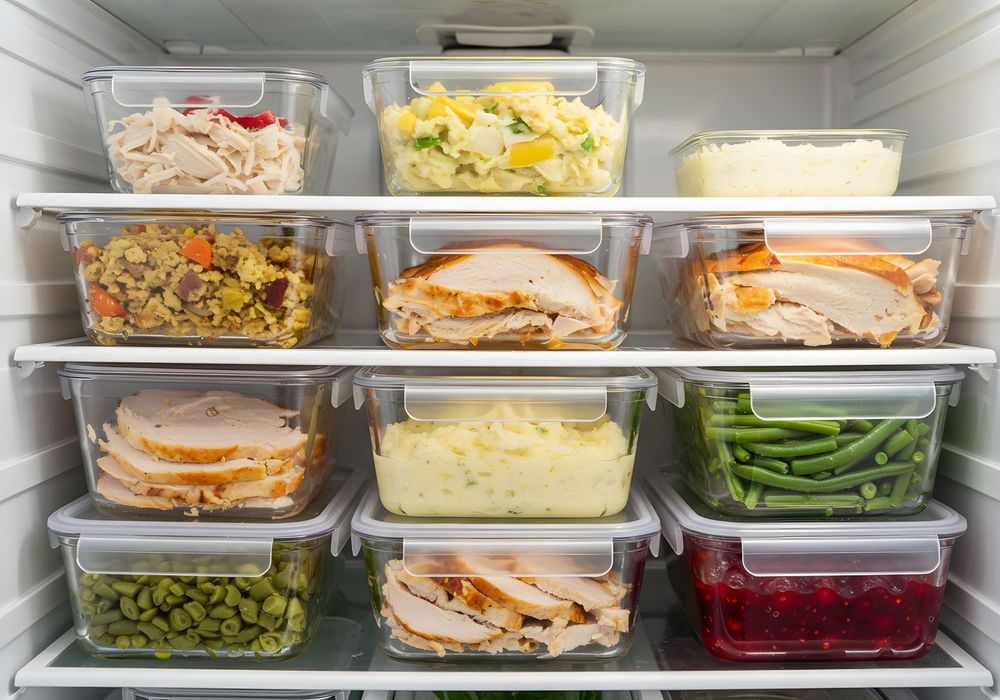
The professional kitchen’s refrigerator — the walk-in, during a normal week of service — is not a collection of finished dishes awaiting service. It is a collection of components in various stages of completion, each of which has multiple potential destinations depending on what the service requires. The roasted peppers from Monday are the antipasto of Tuesday and the sauce component of Wednesday. The chicken stock made Sunday is the braising liquid of Monday and the soup base of Tuesday.
This component thinking — the habit of cooking building blocks rather than complete dishes — is the approach that transforms the home cook from someone who starts from scratch every night to someone who assembles from components, adding the finishing technique that makes them specific rather than the foundational cooking that makes them possible.
The Grain Bowl Is Not a Trend. It Is a System.
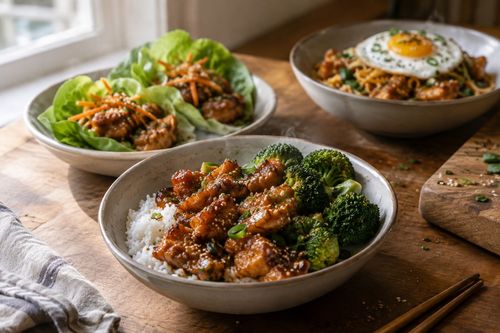
The grain bowl — the collection of cooked grains, roasted or raw vegetables, a protein component, and a dressing that has become ubiquitous in the contemporary food landscape — is often discussed as a trend, a health food category, a response to specific dietary preferences.
It is more fundamentally a system — one of the most practical leftover utilization systems available to a home cook, because it can accommodate almost any combination of cooked components and produce a satisfying, complete meal from what would otherwise be an assortment of odds and ends.
Cooked farro from Monday, roasted sweet potato from Tuesday, a soft-boiled egg from the dozen bought for the week, some greens dressed quickly in a vinaigrette, a handful of the toasted seeds kept in a jar on the counter — these are not the ingredients of a grain bowl in the sense of a recipe that was followed. They are the contents of a refrigerator that was used thoughtfully, assembled into something that is complete and satisfying without any of its components having been cooked specifically for this purpose.
The dressing is the technique that makes the assembly into a dish rather than a collection of components. A vinaigrette made with acid and fat and seasoning — made quickly, tasted and adjusted, applied with enough restraint to season without saturating — lifts a collection of leftovers into something that tastes intentional.
This is the cook’s actual contribution to the leftover meal: not the cooking of the components, which happened yesterday, but the seasoning, the assembly, and the finishing that makes the components coherent.
Eggs as the Universal Leftover Transformer
There is one ingredient that has a unique relationship to leftovers in virtually every culinary tradition — one that appears in the leftover utilization strategies of professional kitchens and home kitchens across cultures precisely because it transforms whatever it touches into something complete.
The egg.
The frittata — the Italian egg dish that is essentially an open-faced omelette cooked in a pan and finished in the oven — exists as a concept specifically to accommodate leftovers. Whatever vegetables, whatever cheese, whatever cooked protein is in the refrigerator can be incorporated into eggs and produced into a dish that is as appropriate for a dinner party as for a solo Tuesday lunch.
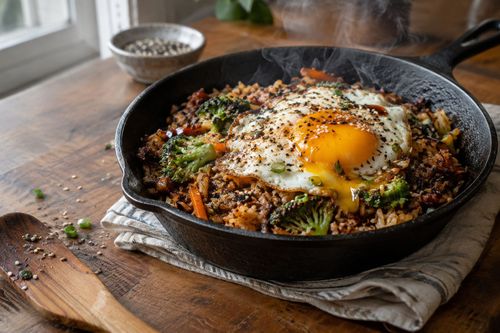
Fried rice — one of the great leftover utilization dishes of Asian cooking — requires day-old rice specifically because fresh rice is too moist to fry properly, and it accommodates whatever protein, whatever vegetable, whatever aromatics are available. The dish exists as a technology for using the cooked rice that is ubiquitous in rice-eating cultures — a deliberate system for converting a refrigerator staple into a complete meal.
Hash — the American tradition of chopping and frying whatever cooked potatoes and protein and aromatics are available — is another egg-adjacent leftover system, one that typically concludes with eggs cooked on top of or alongside the hash, the runny yolk serving as the sauce that ties the otherwise disparate components together.
In each of these traditions, the egg is the element that provides protein, richness, and structural coherence to what would otherwise be an assortment of leftovers — the binder that makes the collection into a dish.
The Soup as a Leftover Destination
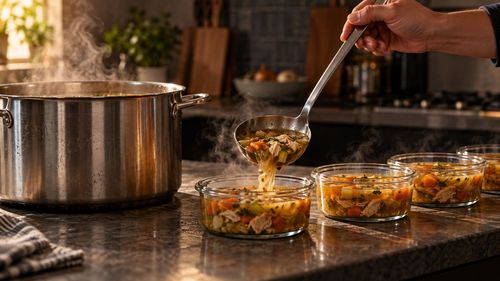
There is no more forgiving destination for leftovers than a soup.
Not because soup is infinitely accommodating of any combination — certain things don’t belong together even in a soup — but because the liquid medium of soup allows flavors to meld in ways that plating separate components cannot, and because the cooking process of soup can rehabilitate ingredients that are past their prime in other preparations.
The minestrone tradition — the Italian vegetable soup that varies by region, by season, and by what is available — is explicitly a leftover utilization system. The vegetables that went into it were the ones that needed to be used. The beans are the protein component that keeps in the pantry. The pasta or the bread added at the end uses what is available. The Parmesan rind dropped in at the beginning is the trim that would otherwise go to waste.
The result of all of this opportunistic assembly, simmered together long enough for the flavors to integrate, is a soup that tastes unified and complete — not like the sum of its leftover parts but like something that was planned.
This is the particular magic of long-cooked soup: it erases the evidence of its own origins. The roasted pepper that went into it doesn’t taste like a leftover roasted pepper. It tastes like part of a soup.
Planning for Leftovers Is Planning to Eat Better
The habit of thinking about leftovers at the moment of initial cooking — not as an afterthought but as a primary consideration — is one of the most significant improvements any home cook can make to the quality and efficiency of their kitchen.
It begins with a shift in how cooking is planned.
Instead of asking “what will I make tonight?” the question becomes “what will I make this week?” — and the answer involves deliberate choices about which components can be made in quantity and used across multiple meals, which preparations will be better on the second day, and which leftovers from one meal will become the foundation of the next.
Cook double the rice on Monday, knowing it becomes fried rice on Wednesday. Make a large batch of braised chickpeas, knowing they are Tuesday’s grain bowl component, Wednesday’s soup addition, and Thursday’s mashed and spread on toast with olive oil. Roast a whole chicken on Sunday and use the carcass immediately for stock, the leftover meat for tacos or a simple pasta later in the week, and the rendered fat for the roasted potatoes that accompany whatever else is made on Thursday.
This way of cooking requires a modest investment in planning that pays significant dividends in the quality and variety of what’s eaten throughout the week — without the daily effort of starting from nothing.
The cook who thinks this way is not cooking leftovers. They are cooking a week.
The Takeaway
The leftover is not the diminished cousin of the real meal. It is, in the hands of a cook who understands its potential, the beginning of the next one.
Think in components rather than complete dishes. Cook in quantities that make the second meal as easy as the first. Use eggs to transform, soup to unify, dressings to assemble. Plan the week rather than the night.
The cook who never starts from scratch isn’t cooking less. They’re cooking smarter — building forward from what already exists, wasting almost nothing, and eating better for the effort.
The best meal of the week is often the one made from what was left of all the others.