
Salad dressing is the last thing most home cooks think seriously about.
It’s the afterthought. The bottle in the refrigerator door. The thing you drizzle on at the end because the salad needs something. Even home cooks who make their dressing from scratch often treat it as a quick combine-and-pour situation — oil, vinegar, maybe some mustard — done in thirty seconds and forgotten.
And then you eat a salad at a good restaurant and the dressing is somehow the best thing on the plate. It coats every leaf evenly. It has a depth and balance that the pantry version never achieves. It tastes like someone actually thought about it.
Someone did.
Emulsification Is the Whole Point
The most fundamental difference between a restaurant dressing and a home dressing has nothing to do with ingredients and everything to do with structure.
Oil and vinegar don’t want to combine. Left to their own devices, they separate — oil floating on top, acid sinking below — and what you pour over your salad is an uneven mixture that delivers a mouthful of sharp acid one bite and a slick of plain oil the next.
Professional cooks build emulsified dressings. An emulsion is a stable suspension of fat and liquid held together by an emulsifying agent — something with molecules that bond to both oil and water simultaneously and keep them from separating. In a vinaigrette, that agent is typically Dijon mustard. In a Caesar, it’s egg yolk. In a creamy dressing, it might be both.
The technique matters as much as the ingredient. To build a proper emulsion, the oil needs to be introduced slowly — in a thin, steady stream — while the other ingredients are being vigorously whisked. This gives the emulsifier time to surround each tiny droplet of oil and suspend it in the acid. The result is a dressing with a creamy, cohesive texture that coats a leaf completely rather than sliding off it.
Pour the oil in all at once and you get a broken dressing. Add it slowly and you get something that holds together, clings, and delivers balanced flavor in every bite.
The Ratio Is a Starting Point, Not a Rule
Most home cooks learn a ratio for vinaigrette — three parts oil to one part acid — and treat it as fixed. Professional cooks treat it as a baseline to be adjusted based on what the dressing is going on and what it needs to accomplish.
A dressing for bitter greens like radicchio or endive benefits from more acid to cut through the intensity. A dressing for delicate butter lettuce needs more oil to avoid overwhelming the leaf. A dressing that will be used as a marinade can go heavier on acid because the meat or vegetable will dilute it over time.
The ratio also shifts depending on the acid itself. A sharp, young red wine vinegar is more assertive than a mellow aged balsamic. Fresh lemon juice has a brightness that white wine vinegar doesn’t. Professional cooks taste their dressing and adjust — more acid, more oil, more salt, a touch of sweetness to balance — rather than measuring and moving on.
The habit of tasting a dressing before it goes on the salad sounds obvious. In practice, most home cooks skip it entirely.
Salt Goes Into the Acid, Not the Oil
Here is a small technique detail that produces a disproportionately large result: salt dissolves in acid, not in oil.
When salt is added to a vinaigrette after the oil has already been incorporated, it sits undissolved in the mixture — you end up with pockets of saltiness rather than a uniformly seasoned dressing. Professional cooks dissolve their salt directly into the vinegar or lemon juice before adding any oil. By the time the dressing is emulsified, the seasoning is evenly distributed throughout.
The same logic applies to other water-soluble flavor additions — sugar, minced shallot, garlic. These go into the acid first, where they can begin to dissolve and meld, before the fat is introduced.
It’s a thirty-second adjustment in process that changes the flavor consistency of the finished dressing completely.
The Dressing Is Made in Advance
Restaurant dressings don’t get made to order. They’re prepared earlier in the day — or the day before — and held in the refrigerator until service.
This matters for flavor in ways that aren’t immediately obvious. A vinaigrette made and used immediately is sharp, with the individual components still distinct. The same vinaigrette made hours earlier has had time to develop — the shallots have mellowed, the garlic has softened and distributed, the mustard has fully incorporated, and the flavors have married into something more cohesive and rounded than the freshly made version.
Minced shallots left to macerate in vinegar for thirty minutes before the oil is added undergo a particularly noticeable transformation — their raw, sharp bite softens into something sweet and deeply savory that becomes the backbone of the dressing rather than an interruption in it.
Making dressing ahead isn’t a time-saving shortcut. It’s a flavor decision.
The Salad Gets Dressed, Not Drowned
The last place home salad dressing goes wrong happens after the dressing is made — in how it gets applied.
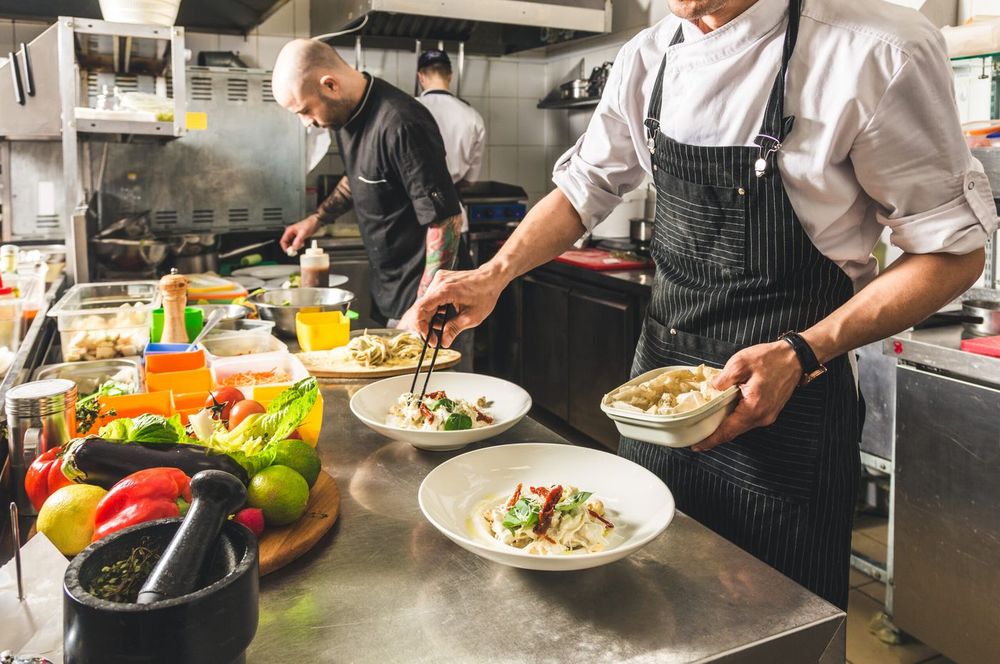
Most home cooks pour dressing over a salad in a bowl and toss. Professional cooks dress their salads in a large, wide bowl with significantly more room than the salad needs, using their hands or tongs to lift and turn the leaves so that every surface makes contact with the dressing.
And critically: they use far less dressing than most home cooks instinctively reach for. A properly emulsified dressing coats efficiently — a light film on every leaf delivers more flavor than a heavy pour that puddles at the bottom of the bowl. The goal is coverage, not saturation. A dressed salad should look barely dressed. Every bite should taste fully seasoned.
The dressing that’s left in the bowl at the end of the meal is the sign of a salad that was overdressed. In a professional kitchen, it’s the sign of a mistake.
The Takeaway
Salad dressing is not an afterthought. In a professional kitchen, it’s a preparation — one that involves technique, timing, and tasting at every stage.
Build the emulsion properly. Dissolve the salt in the acid. Adjust the ratio to the greens. Make it ahead and let it develop. Dress with restraint and cover every leaf.
None of it is complicated. All of it is intentional. And the difference between a dressing made this way and the bottle in your refrigerator door is the kind of difference that makes people ask what restaurant you ordered from.