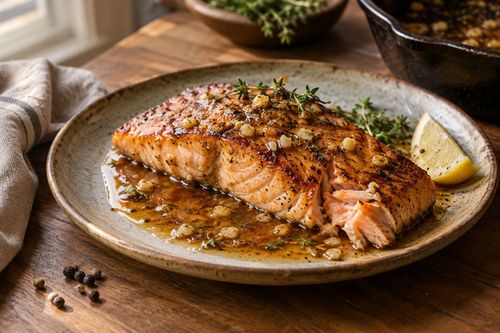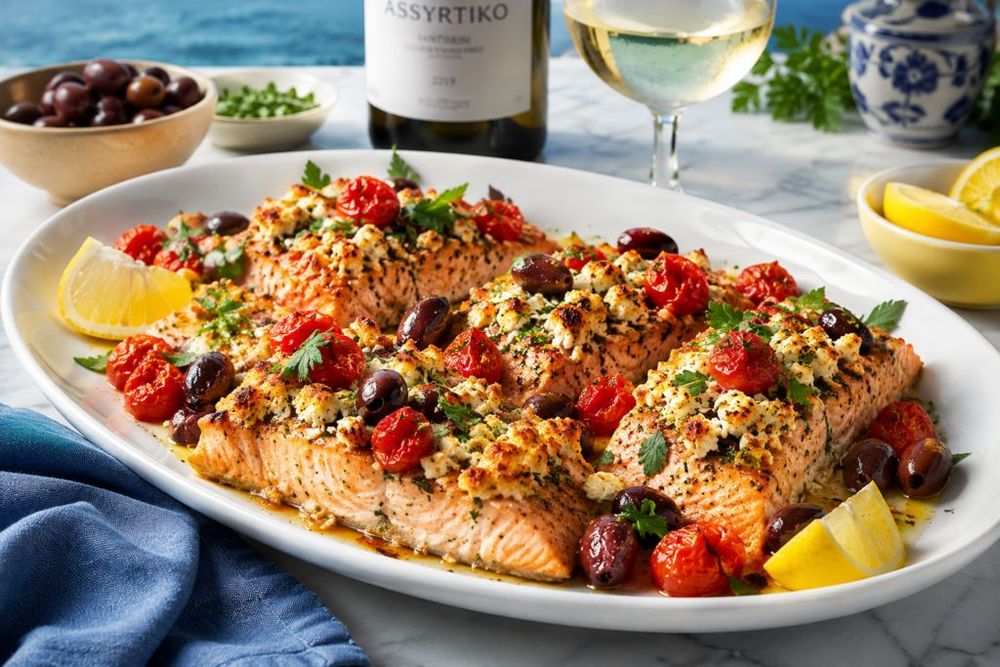

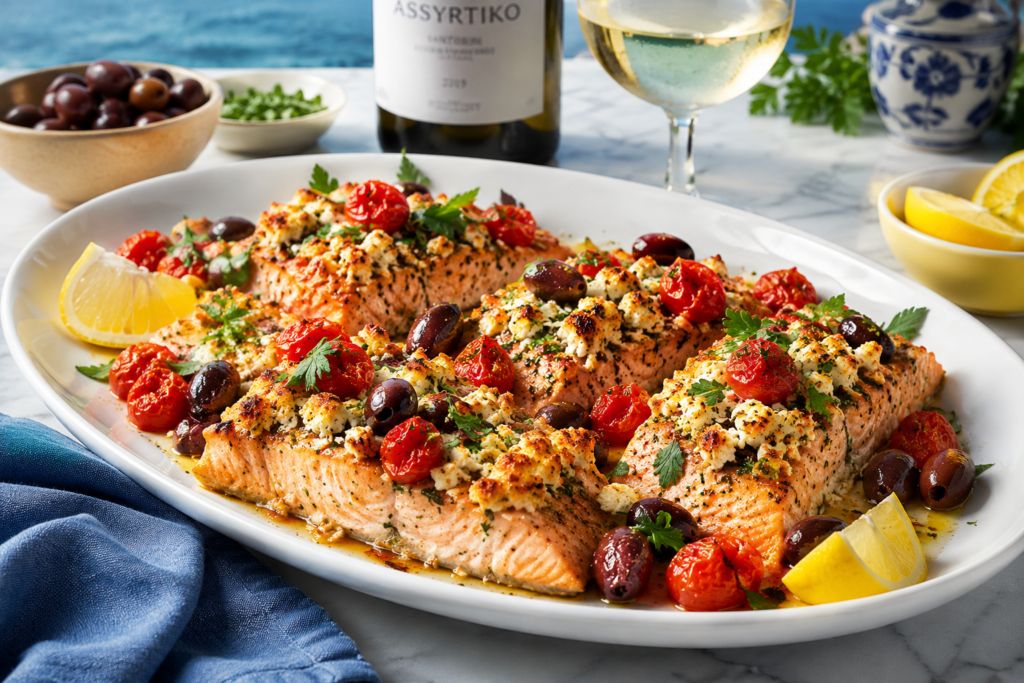


Mediterranean cooking operates on a principle that I find consistently compelling: that bold, assertive ingredients in the right combination don’t compete—they collaborate. Mediterranean Feta Baked Salmon is a perfect demonstration of this principle in action. Feta cheese brings sharp, salty intensity. Kalamata olives contribute briny, slightly bitter depth. Cherry tomatoes offer sweetness and acidity. Lemon provides brightness. Oregano adds herbal complexity. Salmon delivers rich, fatty protein. Any one of these alone would be interesting; together, in the right proportions and cooked together in a hot oven, they create a dish where each component makes the others taste better than they would independently.
The chemistry happening in that oven is worth understanding. As the salmon bakes, its fat renders slightly, carrying the feta’s salt and lemon’s volatile aromatics through the flesh. The cherry tomatoes burst at around 200°F internal temperature, releasing their juice onto the salmon and feta—that liquid becomes a concentrated, slightly sweet basting liquid that redistributes across the surface as it simmers. The feta itself doesn’t melt like mozzarella; its high acidity and low fat content cause it to soften and brown rather than liquefy, creating a textured crust that’s creamy in some spots, slightly caramelized in others. The kalamata olives—oil-cured and concentrated in flavor—release their brine and olive oil into the pan, adding another layer of Mediterranean character.
What makes this recipe particularly intelligent from a culinary design standpoint is how the ingredients handle the oven’s heat differently, creating a dish with genuine textural complexity despite requiring essentially no active technique. You’re not building a sauce, managing a sear, or monitoring precise temperatures beyond setting the oven correctly. You’re assembling components thoughtfully and trusting that heat will do what heat always does—transform raw ingredients into something greater.
From a wine pairing perspective, this dish is one of the most rewarding pairings in the seafood category. The feta’s saltiness, the olives’ brininess, and the lemon’s acidity all function similarly to the way salt in food enhances wine’s fruit and suppresses bitterness. Crisp white wines with mineral character—Greek Assyrtiko especially—find extraordinary resonance with this flavor profile, creating pairings where the wine tastes more vibrant and the food tastes more complex than either would in isolation.
─────────
The Inspiration Behind This Recipe
This recipe draws directly from Greek coastal cooking, where the combination of feta, olives, tomatoes, and olive oil appears in countless preparations celebrating the Aegean’s abundant seafood. Greek cooks have long understood that salt-cured cheese and brined olives create a natural seasoning system for fresh fish—the brine and fat in both ingredients penetrate the flesh during cooking while providing flavor from the exterior. Traditional Greek baked fish preparations (psari sto fourno) typically feature similar flavor profiles, often including white wine in the pan for additional moisture and acidity. The specific use of cherry tomatoes reflects more contemporary cooking sensibility—their concentrated sweetness and tendency to burst during baking create a built-in sauce that traditional preparations achieved through sliced tomatoes or tomato paste. This version honors the spirit of Greek coastal cooking while adapting it for modern home kitchen practicality.
─────────
A Brief History of Greek Coastal Cuisine and Feta
Greek coastal cuisine represents one of the world’s oldest continuous culinary traditions, shaped by geography, climate, and culture over thousands of years. The Aegean’s abundant seafood, combined with olive groves, herb gardens, and sheep and goat herding in the hillsides, created a cuisine defined by simple combinations of intensely flavored ingredients. Feta cheese—produced in Greece since antiquity from sheep’s milk or a sheep-goat blend—received Protected Designation of Origin status from the European Union in 2002, recognizing that genuine feta can only be produced in specific Greek regions using traditional methods. The cheese’s high salt content (a preservation method developed before refrigeration) and distinctive tangy flavor profile make it ideal for cooking applications where other cheeses might become bland. Kalamata olives, from the Peloponnese region, are similarly protected by designation—their distinctive almond shape, dark purple color, and intense flavor coming from specific cultivation and brine-curing methods. Together, these ingredients define Greek Mediterranean cooking’s bold, assertive character.
─────────
Why This Cooking Method Works
The science behind the technique:
- Parchment paper: Prevents sticking without adding fat, makes cleanup effortless, and creates a slightly steamy environment that keeps salmon moist
- Feta mixture as marinade and crust: Applied before baking, it functions simultaneously as a flavor marinade (acid and salt penetrate the fish) and a protective crust
- Lemon juice in feta mixture: Acid begins denaturing surface proteins immediately, acting as a brief cure that improves texture
- Garlic in fat-based mixture: Olive oil carries fat-soluble garlic compounds into the fish during baking
- Cherry tomato placement on top: Bursting during baking creates natural basting liquid that redistributes across the surface
- Kalamata olives’ brine release: Oil-cured olives release their preserved liquid during baking, adding flavor to the pan juices
- Moderate oven temperature (375°F): Cooks salmon through gently without drying out or burning the feta
- Oregano’s heat stability: Unlike delicate herbs, dried oregano’s flavor compounds are relatively stable under oven heat, maintaining character throughout cooking
- Fresh parsley at finish: Added after baking to preserve volatile aromatic compounds that heat would destroy
─────────
Flavor Profile: What to Expect
Bold • Briny • Bright • Herbal • Mediterranean
This salmon delivers a vibrant, assertive flavor profile that’s unmistakably Greek in character. The salmon itself is rich and flaky with its natural buttery quality enhanced by the olive oil. The feta creates a creamy, slightly caramelized crust that’s simultaneously salty, tangy, and rich—distinctly Mediterranean. Burst cherry tomatoes provide sweet, slightly acidic juice that brightens and balances the feta’s intensity. Kalamata olives contribute deep, briny complexity with their distinctive slightly bitter finish that prevents the dish from tasting one-dimensionally rich. Lemon and oregano thread through every component with citrus brightness and herbal character. Fresh parsley provides a clean, green finish. The overall effect is bold and vibrant—confident Mediterranean flavors that taste genuinely of a place and a culinary tradition.
─────────
Tips for Making the Best Mediterranean Feta Baked Salmon
Salmon selection and preparation:
- Choose skin-on fillets (6-8 oz each) for best results—skin protects the flesh from direct heat
- Wild-caught salmon (sockeye, king, coho) has more pronounced flavor that stands up to bold Mediterranean toppings
- Check for pin bones and remove with tweezers before topping
- Pat fillets completely dry before applying feta mixture—moisture prevents proper adherence
- Bring salmon to room temperature (15 minutes) for more even cooking
Feta selection and mixture:
- Use genuine Greek feta (sheep’s milk or sheep-goat blend) rather than generic crumbled feta—the flavor difference is significant
- Block feta that you crumble yourself has better texture and more moisture than pre-crumbled
- The mixture should be thick enough to spread and hold on the fish—adjust olive oil quantity accordingly
- Let the mixture sit 5 minutes after mixing so flavors meld before applying
- Apply generously—this is not the time for restraint
Tomato and olive preparation:
- Halve cherry tomatoes just before using—cut side up allows more juice release during baking
- Choose ripe, sweet cherry tomatoes—their natural sweetness balances the olives’ brininess
- Use genuine kalamata olives (not generic black olives)—their distinct flavor profile is essential
- Roughly chop olives so their brine distributes more evenly across the fish
- Don’t overcrowd the toppings—everything should have space to roast rather than steam
Baking perfection:
- Check salmon at 18 minutes—thickness varies significantly between fillets
- Salmon is done when it flakes easily with a fork and is opaque throughout (or slightly translucent at center for medium doneness)
- Internal temperature of 125-130°F yields medium; 140-145°F is fully cooked
- If feta begins browning too quickly, tent loosely with foil
- The tomatoes should be fully burst and slightly caramelized at the edges
Serving immediately:
This dish is best served straight from the oven while the tomatoes are still sizzling and the feta is at its creamiest. Don’t let it sit.
─────────
Wine Pairing Guide
Perfect pairings for Mediterranean Feta Baked Salmon:
Assyrtiko (Santorini) ★ Best Match
Greece’s greatest white grape produces wines of extraordinary mineral intensity, electric acidity, and citrus character that create remarkable resonance with this dish’s Greek flavors. The wine’s volcanic mineral quality echoes the olives’ brininess and the feta’s salt while its acidity cuts through salmon’s richness. Drinking Greek wine with Greek food creates a pairing where geography and flavor align completely—what grows together genuinely goes together.
Sauvignon Blanc (Loire Valley)
Sancerre or Pouilly-Fumé with herbaceous notes, grapefruit, and mineral complexity that complements oregano and lemon beautifully. The wine’s characteristic brightness mirrors the dish’s Mediterranean vibrancy while its acidity handles the feta’s saltiness and salmon’s richness with equal confidence.
Vermentino (Sardinia or Corsica)
Mediterranean coastal white with citrus, herbal notes, and saline minerality that resonates naturally with this flavor profile. The wine’s slight bitterness on the finish creates interesting dialogue with the kalamata olives, while its body stands up to the feta without overwhelming the salmon.
Grüner Veltliner (Austria)
Citrus, white pepper, and herbal notes with crisp acidity. The wine’s characteristic peppery quality creates interesting resonance with the oregano while its acidity handles both the lemon and the feta’s assertiveness. An underrated but excellent choice.
Chablis
Unoaked Chardonnay with steely minerality and oyster shell character that echoes the olives’ brininess beautifully. The wine’s lean, precise profile won’t overpower the Mediterranean flavors while its citrus notes echo the lemon in the feta mixture.
Alternative pairing: A dry Greek Rosé (made from Xinomavro or Agiorgitiko) bridges the dish’s boldness with Mediterranean authenticity—its acidity and cherry fruit complement both the tomatoes and the salmon while honoring the dish’s Greek character completely.
─────────
Serving Suggestions and Side Pairings
Beautiful presentations:
- Coastal elegance: Serve on a white platter with lemon wedges, extra parsley, and a drizzle of good olive oil
- Individual plates: Place fillet on plate with all the burst tomatoes and olives spooned over, capturing pan juices
- Family-style: Bring the parchment-lined baking sheet to the table—rustic, honest, and dramatic
Ideal side dishes:
- Garlic Rosemary Focaccia Muffins: Essential for soaking up tomato and olive pan juices
- Simple Greek salad: Cucumber, tomato, red onion, and feta echo the main dish’s flavors
- Lemon herb rice: Light, aromatic base that absorbs pan juices beautifully
- Garlic Cream Bucatini: Creamy pasta provides rich contrast to the dish’s bold Mediterranean flavors
- Roasted asparagus: Clean vegetable that complements without competing
- Warm pita bread: For a more casual, communal presentation
For a complete Wine Wednesday spread:
Create a Greek island feast: begin with hummus, warm pita, and olives while wine is poured, serve this salmon as the vibrant centerpiece with a simple Greek salad and lemon rice, and finish with baklava or Greek yogurt with honey and walnuts. Offer Assyrtiko alongside a crisp Sauvignon Blanc to demonstrate how Greek and French wines approach similar flavor territory differently. Add Lemon Butter Scallops as a starter for a fully seafood-focused evening.
─────────
Storage, Reheating, and Make-Ahead Tips
Storage:
- Refrigerate leftover salmon with toppings in an airtight container for up to 2 days
- The flavors actually meld and deepen when stored—leftovers are excellent cold
- Store pan juices with the fish to maintain moisture
Reheating:
- Oven (best method): Reheat at 275°F for 10-12 minutes just until warmed through
- Avoid microwave—uneven heating makes salmon rubbery and diminishes the feta’s texture
- This salmon is genuinely excellent served at room temperature or cold—consider skipping reheating entirely
- Cold leftover salmon over arugula with extra olive oil and lemon is arguably better than reheated
Make-ahead strategies:
- Prepare the feta mixture up to 2 days ahead; refrigerate in an airtight container
- Top salmon fillets with feta mixture up to 4 hours ahead; refrigerate until ready to bake
- Halve tomatoes and chop olives up to 1 day ahead; store separately until ready to top
- For entertaining, assemble completely on the baking sheet and refrigerate; bake when guests arrive—25 minutes is entirely manageable
Cold serving option:
This dish is exceptional served at room temperature as part of a mezze spread or over greens as a composed salad—the Mediterranean flavors actually benefit from the slight cooling that allows them to clarify and intensify.
─────────
Why This Recipe Deserves a Spot in Your Wine Wednesday Rotation
Mediterranean Feta Baked Salmon demonstrates something fundamental about great recipe design: that the most impressive results don’t always require the most technique. This dish asks very little of you technically—mix, spread, top, bake—yet delivers a plate that looks like you’ve been cooking for hours and tastes like you understand something essential about how flavors work together. That’s not luck; that’s the accumulated wisdom of a culinary tradition that’s been pairing these specific ingredients for thousands of years.
What makes this particularly compelling for Wine Wednesday is how the dish’s Mediterranean character creates one of cooking’s most satisfying wine pairing experiences. The combination of feta’s salt, olives’ brine, and lemon’s acidity creates a flavor profile that makes mineral-driven white wines taste extraordinary—brighter, more vibrant, more complex than they would alongside a simpler preparation. Assyrtiko from Santorini paired with this dish is a revelation—two things from the same cultural tradition and geographical region finding perfect harmony on your table on a Wednesday evening.
The recipe also represents an important principle in home cooking: that building a library of diverse, world-inspired dishes makes your cooking more interesting and your wine pairing more educational. Italian pasta, French braises, and Greek seafood all demand different wines for different reasons, and cooking your way through these traditions teaches you more about wine than any book can. This Mediterranean salmon is a lesson in how salt, acid, and minerality interact with wine—served with a plate of something genuinely delicious.
Most importantly, this is food that transports you. The moment you pull this from the oven—the burst tomatoes glistening, the feta golden at the edges, the olives dark and concentrated, the whole thing smelling of oregano and lemon—you’re somewhere coastal and warm and unhurried. That sense of place through food is one of cooking’s greatest gifts, and sharing it over a glass of Greek white wine on a Wednesday evening is exactly the kind of small luxury that makes an ordinary week feel less ordinary.
Pour something mineral and cold, serve immediately while everything is at its peak, and let the Mediterranean come to your table.
Yamas!