
Flavor gets all the attention.
When a dish is memorable, we talk about how it tasted — the depth, the seasoning, the balance of acid and fat and salt. When something falls short, we adjust the recipe, change the ingredients, reach for more spice or more salt or a different sauce.
What we rarely talk about — and what professional cooks think about constantly — is texture.
Texture is the part of eating that happens before flavor fully registers. It’s the first thing the mouth processes when food arrives — the resistance, the give, the crunch, the creaminess — and it shapes the entire experience of the flavor that follows. A dish that tastes right but feels wrong is a dish that doesn’t fully satisfy. And a dish where the textures have been thought through and deliberately constructed is a dish that satisfies on a level most people can feel but few can articulate.
Professional cooks think about texture the way they think about seasoning — as something to be built, contrasted, and managed throughout the entire cooking process.
Contrast Is the Principle Behind Every Great Dish
Ask a professional cook why a dish works and the answer almost always involves contrast — not just in flavor, but in texture.
A braise that has been cooking for hours produces meat that is tender to the point of falling apart. That tenderness is delicious. It is also, on its own, monotonous — bite after bite of the same yielding softness without variation. This is why a well-constructed braise arrives with something crunchy on top: toasted breadcrumbs, fried shallots, fresh herbs with structure. The crunch doesn’t just add a textural note — it makes the tenderness of the meat taste more tender by contrast.
The same principle appears everywhere in professional cooking. A creamy soup gets a garnish with bite. A soft, rich dessert gets a brittle tuile or a crumble. A piece of silky fish gets a crispy skin. The smooth gets the crunchy. The rich gets the fresh. The soft gets the sharp.
Home cooks who plate a dish without thinking about textural contrast are often producing food where everything in the bowl has the same consistency — and wondering why it feels less satisfying than a restaurant version that uses identical ingredients. The ingredients aren’t the difference. The intentional contrast is.
Achieving Crunch Requires Understanding What Destroys It
Crunch is the most fragile texture in cooking. It exists in a narrow window between raw and soggy, and it requires specific conditions to achieve and maintain.
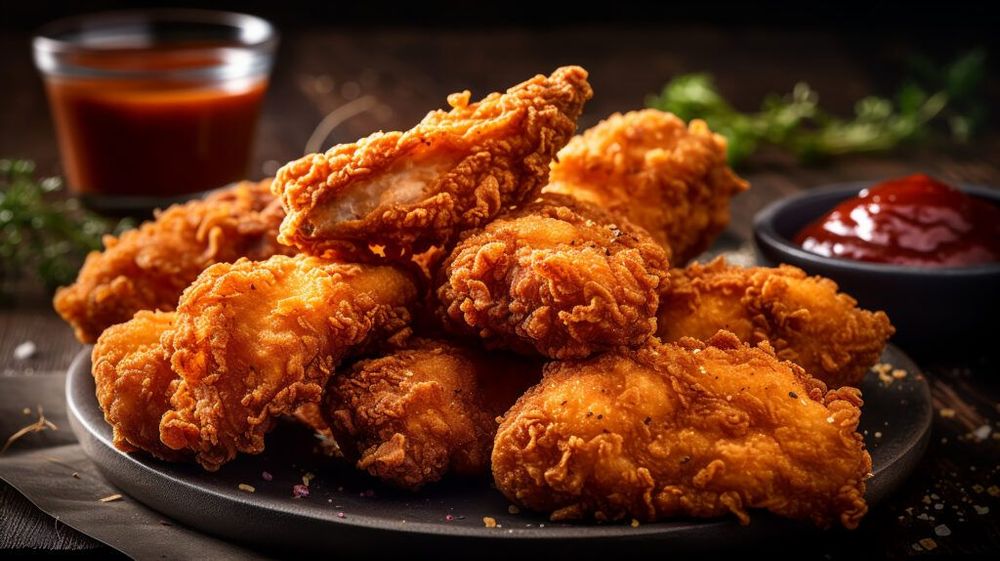
Professional cooks who fry, roast, or sear for crunch understand that moisture is its primary enemy. Steam trapped against a crispy surface — from a lid placed on a pan, from food piled on top of itself, from a sauce applied too early — converts crunch to soft in seconds. This is why fried food drains on wire racks rather than paper towels. Why roasted items come out of the oven and get plated immediately rather than covered and held. Why sauces go underneath a piece of crispy fish rather than on top of it.
The architecture of the plate — which component goes where, what touches what, what gets added last — is a decision being made around texture as much as around presentation. In a professional kitchen, a crispy element is protected until the last possible moment. It is the last thing plated, sauced around rather than over, and served immediately before time and moisture can do their work.
Home cooks who plate everything at once and then carry the dish to the table are losing texture in those minutes between kitchen and eating. Professional cooks plate with the knowledge that time is working against the crunch — and they act accordingly.
Softness Is Not the Same as Tenderness
Here is a distinction that professional cooks make constantly that most home cooks conflate: the difference between food that is soft and food that is tender.
Softness is the absence of resistance. Tenderness is the presence of the right resistance — enough structure to give the teeth something to find, but yielding easily when found. The difference is meaningful, and overcooking is the most common way the distinction gets lost.
A chicken breast cooked to exactly the right temperature is tender — it yields cleanly to a knife, pulls apart with minimal effort, and has a texture that feels intentional. The same chicken breast cooked ten degrees further is soft — it shreds without resistance, has lost its structural integrity, and feels somehow less satisfying despite being more cooked.
Professional cooks pursue tenderness, not softness. They pull proteins at the precise moment when resistance yields without disappearing. They cook vegetables to the point where a knife enters with slight resistance at the center — not to the point of complete collapse. They understand that the last few degrees of cooking are often the most consequential, and they treat the endpoint as a target to hit precisely rather than a threshold to exceed.
How Fat Creates Texture From the Inside
Texture in a finished dish is not always about what’s on the surface. Fat — the amount present in an ingredient, the way it’s rendered during cooking, the manner in which it’s incorporated into a sauce or a batter — creates texture from the inside in ways that home cooks rarely account for.
A well-marbled piece of beef has fat running through its muscle fibers. During cooking, that intramuscular fat renders and lubricates the surrounding meat, producing a richness of texture — often described as buttery or silky — that a lean cut cannot replicate regardless of technique. This is why professional cooks select cuts with appropriate fat content for the cooking method, rather than defaulting to the leanest option.
In sauces, emulsified fat produces a completely different texture than non-emulsified fat. A vinaigrette that has been properly emulsified coats the palate smoothly and clings to food evenly. The same ingredients poorly emulsified produce a sauce that feels oily on the tongue — the fat and acid separating against the palate rather than working together.
In baking, fat interrupted by layers — as in laminated doughs like croissant or puff pastry — produces the shattering flakiness that is one of the most prized textures in pastry. Fat fully incorporated into a batter produces tenderness and moisture. The same ingredient, handled differently, produces entirely different textural outcomes.
The Role of Temperature in Texture at the Table
There is one more dimension of texture that professional kitchens manage deliberately and home kitchens often overlook: the effect of serving temperature on how texture is experienced.
Fat-based textures change dramatically with temperature. A sauce that is perfectly silky and cohesive when hot will congeal and feel heavy at room temperature. A cheese that is appropriately firm when cold will be exactly right at room temperature. Chocolate ganache that sets to a dense, fudgy texture when cold becomes luxuriously soft when brought to room temperature before serving.
Professional pastry chefs and cooks make temperature decisions specifically around texture — serving certain components warm, others cool, and occasionally both in the same dish to create a temperature contrast that doubles as a texture contrast. A warm brownie against cold ice cream is not just a temperature experience. It is a texture experience — the soft give of warm chocolate against the resistance of frozen cream — that produces a satisfaction greater than either component delivers alone.
Home cooks who serve everything at the same temperature — everything warm, or everything whatever temperature it happens to be — are missing a dimension of texture management that costs nothing to apply.
The Takeaway
Texture is not decoration. It is not the final flourish on an otherwise complete dish. It is a fundamental dimension of cooking that shapes how flavor is experienced, how satisfying a meal feels, and whether a dish is merely good or genuinely memorable.
Think about contrast before plating. Protect crunch until the last moment. Pursue tenderness rather than softness. Choose cuts and ingredients with fat content appropriate to the texture you’re building. And consider serving temperature as a texture decision, not just a practical one.
The flavors in a dish are the conversation. The textures are the room the conversation happens in.