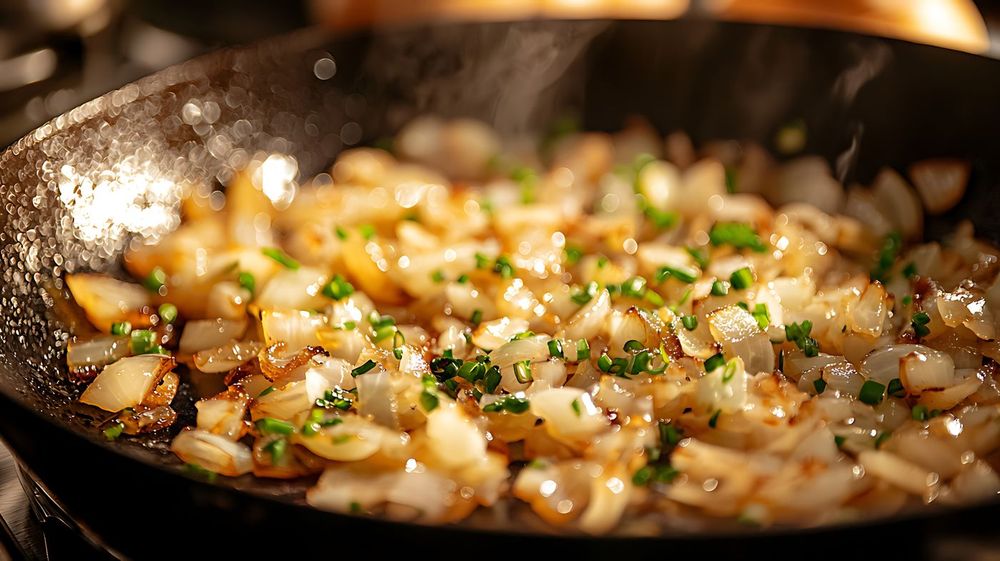

There is a moment in cooking that is so familiar it has become invisible.
The onion hits the pan and begins to soften. The butter foams and then quiets. The surface of the steak makes contact with the cast iron and the kitchen fills with a smell that is, by almost universal agreement, one of the most appealing things a human nose can encounter.
Something is happening in that pan that is genuinely extraordinary — a cascade of chemical reactions so complex that food scientists have spent decades studying it without fully mapping every pathway it contains. It produces hundreds of distinct flavor compounds simultaneously. It is responsible for the crust on a loaf of bread, the color of a roasted coffee bean, the depth of a properly seared piece of meat, the richness of a dark caramel.
It is called the Maillard reaction. And understanding what it actually is — not just that it exists, but what it requires and what it produces — changes the way every browning decision in the kitchen gets made.
Two Ingredients, Hundreds of Outcomes
The Maillard reaction was first described by French chemist Louis-Camille Maillard in 1912, who noticed that amino acids and reducing sugars, when heated together, produced brown compounds with complex aromas. Over a century of subsequent research has confirmed that his observation was the tip of an extraordinarily complex iceberg.
The reaction requires two things: amino acids — the building blocks of protein — and reducing sugars, which are specific forms of sugar capable of participating in the reaction. When heat is applied in the right conditions, these two compounds begin interacting in a cascade of reactions that produce melanoidins — the brown pigments responsible for color — and hundreds of volatile aromatic compounds responsible for flavor.
The specific compounds produced depend on which amino acids and which sugars are present, the temperature at which the reaction occurs, the moisture level of the food, the pH of the environment, and the duration of the heating. This is why the Maillard reaction produces such dramatically different results in different foods: the brown crust of a baguette tastes nothing like the sear on a steak, which tastes nothing like the roasted surface of a coffee bean — even though the same fundamental reaction is producing all three.
The reaction is not a single event. It is a branching network of simultaneous chemical pathways, each producing different compounds, each influencing the others. The complexity of roasted and browned flavors — the reason they are so much more interesting than the raw ingredients that produced them — is the direct result of this chemical branching.
Temperature Is the Switch
The Maillard reaction begins occurring at temperatures above approximately 280°F — though it proceeds slowly at that threshold and accelerates significantly as temperature rises. Its optimal range for most foods is between 300 and 500°F. Above certain temperatures, the reaction transitions into pyrolysis — burning — which produces bitter, acrid compounds rather than the desirable ones the Maillard reaction generates.
This temperature dependency explains almost everything about the browning decisions that good cooking requires.
It explains why a crowded pan produces steamed, gray meat rather than a seared crust: the moisture released by too much food in too small a space keeps the surface temperature of the meat below the Maillard threshold, regardless of how hot the burner is running. The water must evaporate before browning can begin, and in a crowded pan, there is too much of it evaporating too slowly for the surface to reach the necessary temperature.
It explains why dry food browns better than wet food: surface moisture must be driven off before the temperature of the food’s surface can rise above 212°F — the boiling point of water — let alone the 280°F minimum for Maillard reactions. This is why patting a steak dry before searing is not a minor refinement but a fundamental requirement. Every drop of surface moisture is heat energy spent on evaporation rather than browning.
It explains why sugar-brushed items brown faster: the additional reducing sugars on the surface provide more reactants for the Maillard reaction and accelerate its progress. And it explains why alkaline environments accelerate browning — which is why a small amount of baking soda added to onions being caramelized speeds the process dramatically, by raising the pH and making the Maillard reaction proceed faster at the same temperature.
Caramelization Is Not the Same Thing
There is a persistent conflation in cooking language between the Maillard reaction and caramelization — two distinct chemical processes that both produce browning but through entirely different mechanisms.
Caramelization is the thermal decomposition of sugar alone — no amino acids required. When sugar is heated past its melting point, it begins breaking down and recombining into hundreds of different compounds, producing the characteristic color, bitterness, and complexity of caramel. Different sugars caramelize at different temperatures: fructose begins caramelizing around 230°F, glucose around 320°F, sucrose around 340°F.
The Maillard reaction requires both amino acids and sugars and begins at a lower temperature than most caramelization. In foods that contain both protein and sugar — which is most food — both reactions occur simultaneously and interact with each other, which is part of why browned food is so complex.
The practical significance of this distinction is real: a pan of pure onions — which contain sugar and amino acids — undergoes both reactions during the long, slow browning process that produces genuinely caramelized onions. A pan of pure sugar produces only caramelization. Understanding which reaction is responsible for which flavors in a given food helps the cook understand which conditions to create and which to avoid.
Controlling the Reaction at Home
The Maillard reaction can be encouraged, accelerated, or inhibited by specific cooking decisions — and knowing which decision produces which result is one of the most practically useful pieces of food science a home cook can internalize.
Dry the surface. Every technique for achieving a good sear or a well-browned crust begins here. Pat proteins dry with paper towels. Leave vegetables uncovered in the refrigerator before roasting to allow surface moisture to evaporate. Salt proteins well in advance and allow the drawn moisture to reabsorb, leaving the surface drier than it started.
Use the right fat and temperature. The fat in a pan conducts heat to the food’s surface — but the pan must be genuinely hot before the fat goes in, and the fat must reach its own cooking temperature before the food is added. A pan that isn’t hot enough when food goes in means the food’s surface temperature rises slowly, allowing steam to build rather than browning to begin.
Avoid overcrowding. The single most reliable way to prevent browning is to put too much food in a pan at once. Use two pans, cook in batches, give every piece of food enough space that its released moisture can evaporate rather than accumulating in the cooking environment.
Use baking soda selectively. A small pinch of baking soda added to onions being cooked, or brushed onto the surface of a roast chicken skin, raises the pH of the food’s surface and meaningfully accelerates the Maillard reaction — producing deeper browning at the same temperature in less time. The amount required is small enough to have no detectable effect on flavor, but its impact on browning is significant.
Why Browned Food Tastes Better
The question of why browned food tastes more complex and satisfying than unbrowned food has an answer that is simultaneously chemical and sensory.
The Maillard reaction produces compounds — pyrazines, furans, thiophenes, and dozens of others — that register on the human olfactory system as roasted, nutty, caramelized, savory, and complex. These compounds did not exist in the raw ingredient. They are created by the reaction itself, which is why cooking changes the flavor of food so dramatically rather than merely heating it.
Beyond the specific compounds, the Maillard reaction produces flavor complexity — a multiplicity of simultaneous aromatic signals — that the human sensory system processes as depth and richness. A raw chicken breast has a relatively simple flavor profile. A properly seared chicken breast has dozens of additional flavor compounds layered on top of its base flavor, producing the experience of something fundamentally more interesting.
This is also why the crust of bread is more flavorful than the crumb, why the exterior of a roast is more complex than the interior, why seared meat tastes richer than poached meat made from the same cut. The surface that experienced the Maillard reaction is carrying the flavor. The interior, protected from the heat by its own mass, never reached the temperature required for the reaction to occur.
The Takeaway
The Maillard reaction is not a culinary concept. It is a chemical reality that underlies almost every moment of browning in every kitchen in the world — and understanding it changes the decisions a cook makes about temperature, moisture, crowding, and timing in ways that are immediately and concretely useful.
Dry food browns. Wet food steams. Hot pans sear. Crowded pans stew. Alkaline surfaces color faster. High heat produces complexity. Burned surfaces produce bitterness.
Each of these is not a rule to memorize but a consequence of chemistry to understand. And a cook who understands the chemistry doesn’t need to memorize the rules.
The pan already knows what to do. The cook’s job is to give it the conditions to do it.