
Every dish has an origin.
Not always a clean one. Not always a documented one. Not always an origin that the people who claim it would fully recognize or endorse. But somewhere behind every iconic preparation — the dish that has transcended its original context to become something recognized and sought and eaten across the world — there is a story.
Often the story is more complicated than the dish’s current reputation suggests. The origin is disputed, or multiple origins are claimed, or the dish that is now considered definitive was, for most of its history, something quite different from what it has become. The story involves migration and poverty and improvisation and the specific encounter between different culinary traditions that produces, sometimes, something new and lasting.
These stories are worth knowing — not because they change the taste of the food, but because they change the relationship with it. The dish that has a history is a different eating experience from the dish consumed without one.
Cacio e Pepe and the Mathematics of Simplicity
There are few dishes in the world whose reputation rests on a combination so minimal that it seems almost impossible that it could be worth the attention it receives.
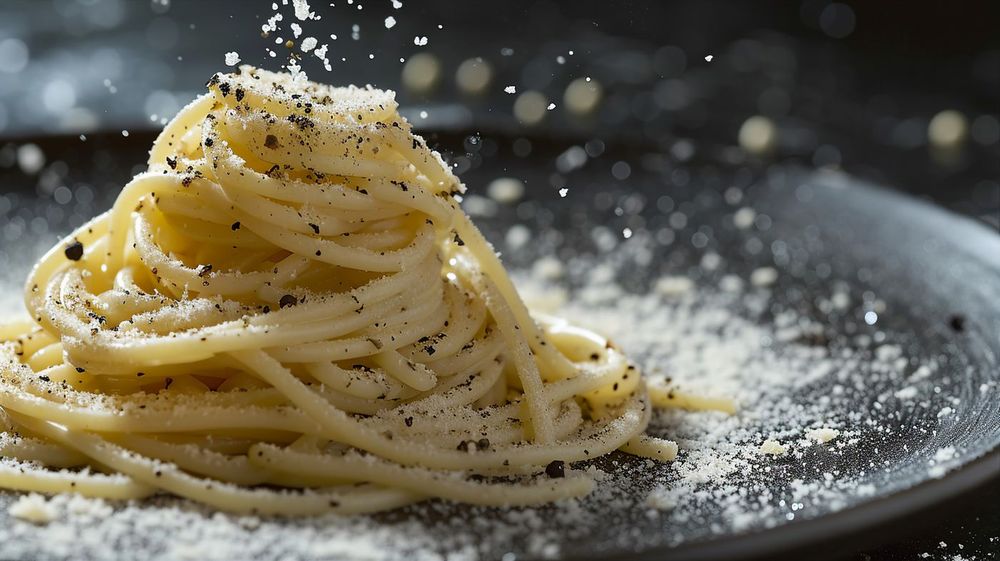
Cacio e pepe — the Roman pasta preparation of spaghetti or tonnarelli with Pecorino Romano cheese and black pepper — contains three ingredients. That is the entirety of its composition. No olive oil, no butter, no garlic, no protein, no vegetable. Three ingredients, combined with technique and pasta water, into something that serious food people travel to Rome specifically to eat.
The dish’s origins are contested in the way that most Roman pastas are contested — with strong opinions and insufficient documentation. The most plausible historical account connects cacio e pepe to the shepherds of Lazio and the surrounding regions who drove their flocks between summer and winter pastures in the practice called transumanza. These shepherds carried with them the provisions most suited to long journeys on foot: dried pasta, aged Pecorino (which keeps indefinitely without refrigeration), and black pepper (which was among the most widely available spices in the pre-modern world and which has documented use as a preservative and a warmth-generator in cold weather).
The combination of these three provisions — cooked in the water available along the route, combined with the technique of emulsification that turns pasta water and cheese into a sauce — produced a dish of remarkable depth from the most spartan of ingredients.
What makes cacio e pepe genuinely difficult — what separates the version eaten in the right Roman trattoria from most attempts to replicate it — is the emulsification. The starchy pasta water, combined with finely grated Pecorino and the mechanical agitation of tossing the pasta, must form a cohesive, creamy sauce without the cheese clumping. The specific ratio of water to cheese, the temperature at which the combination occurs, the quality of the pasta water — all of this determines whether the result is silky and unified or grainy and separated.
Three ingredients. Infinite room to get it wrong.
Chicken Tikka Masala and the Dish That Has No Country
Chicken tikka masala is simultaneously one of the most popular dishes in the United Kingdom — where it was once described as a national dish — and one of the most contested in terms of its origins, its authenticity, and what it actually represents in the complex history of food, empire, and cultural encounter.
The dish — chunks of marinated, yogurt-coated chicken (tikka) roasted in a tandoor and then served in a creamy, tomato-based masala sauce — has no clear ancestor in the classical Indian culinary tradition. The tikka preparation is genuinely Indian. The masala sauce that accompanies it in the British version — mild, creamy, slightly sweet, calibrated to a palate shaped by British food preferences — is not.
The most commonly repeated origin story places the dish’s invention in Glasgow in the 1970s, at a Pakistani-owned restaurant where a customer complained that the chicken tikka was too dry and the chef responded by adding a sauce — allegedly improvised from a can of tomato soup, cream, and spices. Whether this specific story is true is impossible to verify. What it captures accurately is the general mechanism of the dish’s creation: South Asian cooking tradition meeting the palate preferences of a British customer in the specific context of the immigrant restaurant, producing something new that belongs fully to neither tradition.
The contested authenticity of chicken tikka masala reveals something important about the nature of cuisine — that the dishes most loved by large numbers of people are often the ones that exist in the borderland between traditions, that were created in the encounter between cultures rather than within any single one. The dish has no country in the sense of a single authentic national origin. It has a history — a specific set of circumstances, people, and cultural encounters — that produced it.
That history is part of what it tastes like.
The Croissant and Its Unexpected Origin
The croissant — the butter-laminated, crescent-shaped pastry that is the most iconic product of the French boulangerie and that has become a global symbol of French culinary culture — is not, in its origins, French.
The crescent-shaped bread has its origins in Austria — specifically in the kipferl, a crescent-shaped pastry that has been documented in Viennese baking tradition since the thirteenth century. The migration of the croissant from Vienna to Paris is attributed, in the most commonly repeated account, to the Austrian entrepreneur August Zang, who opened a Viennese bakery in Paris in 1838 or 1839 and introduced Parisian consumers to the Viennese pastry tradition, including crescent-shaped breads.
What the French did with the Austrian form was the transformation that produced the modern croissant. The Viennese kipferl was a relatively dense, bread-like pastry. French bakers applied to it the technique of lamination — the specific process of folding butter repeatedly into the dough to create hundreds of distinct layers that produce the shatteringly flaky, dramatically layered texture that distinguishes the French croissant from its Austrian ancestor.
This transformation — the application of French technique to an Austrian form — produced something that is neither Austrian nor French in a simple sense. It is the product of cultural encounter, of the specific moment when an immigrant bakery tradition met the technical refinement of the French pastry tradition and the two produced something that neither had developed independently.
The croissant is now so completely identified with France that its Austrian origins are largely unknown. This is not cultural theft so much as cultural transformation — the process by which borrowed forms become native through the specific contributions of a new context.
Spaghetti Bolognese and What It Isn’t
There is a dish eaten by millions of people around the world that bears the name of one of Italy’s great cities and that bears almost no relationship to the actual culinary tradition of that city.
Spaghetti Bolognese — the combination of spaghetti with a meat sauce that has become one of the most commonly cooked dishes in homes across the English-speaking world — is not a dish that the people of Bologna would recognize as their own.
The actual preparation of Bologna — ragù alla Bolognese — is made with tagliatelle, not spaghetti. The sauce is a slow-cooked preparation of minced or finely chopped beef and pork, cooked with onion, celery, carrot, wine, milk or cream, and very little tomato — the tomato element so restrained that the sauce is primarily meat-colored rather than red. It is rich, subtle, and deeply savory in a way that is completely different from the tomato-heavy meat sauces that most of the world understands as “Bolognese.”
The specific transformation that produced the global version of “spaghetti Bolognese” happened through a process of simplification and adaptation as the dish moved through Italian immigrant communities and into the mainstream food cultures of countries that lacked both the specific pasta shapes of Bologna and the specific ingredients and techniques that produced the original sauce.
The result is a dish that the Italians of Bologna — who have actually registered the official recipe of ragù alla Bolognese with the Bologna Chamber of Commerce — have a complicated relationship with. It is their city’s name on a dish that is almost entirely unlike their city’s food.
French Onion Soup and the Power of Poverty
French onion soup — the deeply savory broth-based soup topped with a crouton and a gratinéed crust of melted Gruyère or Comté — is one of the most widely known and most widely attempted preparations in French cooking, and one whose reputation as a sophisticated bistro classic somewhat obscures its origins in genuine poverty.
The core of the dish — onions cooked slowly in fat until deeply caramelized, then simmered in liquid — is one of the most fundamental preparations of frugal cooking across multiple culinary traditions. Onions were the most widely available, most affordable, and most perishable vegetable in the pre-modern kitchen — the thing that was always there, that needed to be used, and that responded to slow cooking in fat with a transformation that produced something far beyond what their price suggested.
The specific origins of the dish in its current form are attributed, in the most commonly repeated account, to the working-class eating establishments of Paris — the bouillon restaurants that fed the laboring classes of the nineteenth century city with inexpensive, nourishing preparations that made the most of the least expensive ingredients. The bread crouton that topped the soup used stale bread — the bread that would otherwise have been wasted. The cheese that covered and browned under the heat was the economical finishing touch that transformed an inexpensive preparation into something satisfying enough to constitute a meal.
The dish that is now sold for considerable sums in bistros across Paris and the world was, for most of its history, the food of people who couldn’t afford anything else.
Tacos and the Impossible Task of a Single Origin
The taco — the preparation of a corn tortilla wrapped around a filling that has become one of the most consumed foods in North America — is a dish whose origins are simultaneously specific and irreducible to a single story.
The corn tortilla has its origins in the ancient mesoamerican civilizations that domesticated corn and developed the process of nixtamalization — treating dried corn with an alkaline solution, typically calcium hydroxide, which makes its niacin bioavailable and transforms it into a more nutritious and more workable ingredient than untreated corn. The tortilla that resulted from this process — flat, flexible, produced without leavening or fat — has been documented in Mesoamerican foodways for thousands of years.
The specific form of the taco — the tortilla as a vehicle for a filling rather than as a flatbread eaten alongside a meal — is harder to date. The most common academic account suggests that the word “taco” in the culinary sense appears in Mexican documentation in the nineteenth century, associated with the silver mines of Hidalgo, where “tacos” referred to the small explosive charges used in mining and then, by extension, to the small rolled preparations of food that workers ate.
The specific varieties of taco that exist today — the pastor of Mexico City, the birria of Jalisco, the carnitas of Michoacán, the lengua and cabeza of the northern states — each reflect the specific agricultural, cultural, and historical conditions of the region that produced them. The global taco that exists outside Mexico is something else again — shaped by the immigrant experience, by the specific adaptations of Mexican American cooking, by the commercial interests that have popularized specific forms at the expense of others.
The taco is not one dish. It is a concept — one of the most generative and most adaptable in all of food — that has produced thousands of specific expressions in thousands of specific contexts.
The Takeaway
The iconic dishes that have spread across the world and become part of global food culture are not simply good food. They are stories — of poverty and improvisation and migration and cultural encounter, of the specific human circumstances that produced them and the specific human mechanisms that spread them.
Knowing the story changes the eating. The cacio e pepe that connects to the shepherds of Lazio. The croissant that began in Vienna. The chicken tikka masala that belongs to no single culinary tradition. The French onion soup that was the food of the poor.
Every iconic dish was, once, just food that someone made from what they had.
The story is how it became more than that.