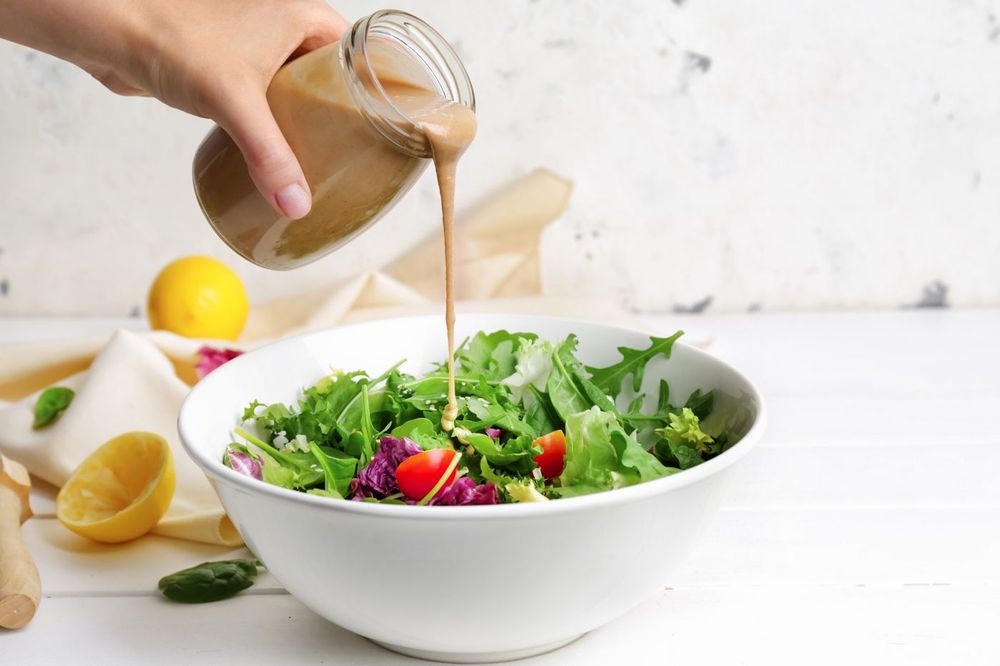

You make a vinaigrette from scratch.
Oil, vinegar, maybe some mustard or honey. You whisk it together and it looks perfect—smooth and emulsified.
Five minutes later, it’s separated. Oil floating on top, vinegar on the bottom. A broken mess that won’t coat salad properly.
You shake it up again. It comes back together temporarily, then separates again as soon as you stop moving it.
Restaurant dressings stay emulsified. They pour smoothly from the bottle hours after being made. They coat greens evenly instead of pooling at the bottom of the bowl.
The difference isn’t magical ingredients or industrial equipment.
It’s understanding what holds emulsions together and using techniques that create stable dressings instead of temporary mixtures that fall apart immediately.
You’re Not Using an Emulsifier
Oil and vinegar don’t want to mix. They’re chemically opposed—oil is hydrophobic, vinegar is water-based.
Whisking creates a temporary suspension where tiny oil droplets are dispersed in the vinegar. But without something to stabilize those droplets, they quickly coalesce and separate.
Emulsifiers bridge the gap. They have molecules that bond with both oil and water, keeping everything suspended.
Common emulsifiers: mustard, egg yolk, honey, garlic paste, mashed anchovies.
Chefs almost never make vinaigrettes with just oil and vinegar. They always include an emulsifier.
Home cooks often make the most basic version—three parts oil to one part vinegar, nothing else—and wonder why it won’t stay together.
Add mustard. Even half a teaspoon helps dramatically. Or honey. Or mince garlic into a paste.
This isn’t optional if you want dressing that stays emulsified. It’s required.
The Proportions Are Wrong
Too much oil relative to emulsifier and vinegar makes emulsions unstable.
There’s not enough water-based liquid or emulsifier to suspend all that oil. The excess separates out.
The classic ratio is three parts oil to one part vinegar. But that assumes adequate emulsifier.
Without sufficient emulsifier, even this ratio won’t hold.
With strong emulsifiers like egg yolk, you can push ratios higher—four or five parts oil to one part vinegar.
Chefs adjust ratios based on what emulsifiers they’re using and how thick they want the dressing.
Home cooks often just eyeball everything. Sometimes they end up with too much oil. The emulsion can’t support it.
Measure, at least initially. Three to one is the standard starting point. Adjust from there based on what emulsifiers you’re using.
You’re Adding Oil Too Fast
This is the single biggest mistake when making emulsified dressings.
Dumping all the oil in at once overwhelms the emulsifiers. They can’t organize fast enough to stabilize all that oil. The mixture breaks.
Chefs add oil slowly—a thin stream while whisking constantly. This gives emulsifiers time to surround each droplet as it’s added.
The slower you add oil, the more stable the emulsion.
For mayonnaise-style dressings, this is critical. Start with drops, then progress to a thin stream as the emulsion builds.
Home cooks often pour oil in large glugs. The emulsion never forms properly because the emulsifiers are overwhelmed.
Add oil slowly. Like, absurdly slowly. Especially at the beginning. Once the emulsion starts forming, you can add faster—but not much.
Patience here is what creates stable dressing.
The Ingredients Are Different Temperatures
Oil that’s cold from the refrigerator doesn’t emulsify as easily as room-temperature oil.
Cold oil is more viscous. It doesn’t want to break into tiny droplets. The emulsion struggles to form.
Temperature differences between ingredients also create instability. Cold oil added to room-temperature vinegar behaves differently than when everything is the same temperature.
Chefs bring all ingredients to room temperature before making dressings. Everything emulsifies more smoothly when temperatures are consistent.
Home cooks often grab cold oil from the pantry and cold vinegar from the fridge. The temperature difference works against emulsification.
Let ingredients sit out for 30 minutes before making dressing. Room temperature ingredients emulsify more easily and create more stable dressings.
You’re Not Whisking Vigorously Enough
Creating an emulsion requires mechanical energy. You need to physically break oil into tiny droplets and disperse them throughout the water-based liquid.
Gentle stirring doesn’t create enough force. The oil droplets stay too large. They separate quickly.
Vigorous whisking—fast, continuous motion—breaks oil into microscopic droplets. The smaller the droplets, the more stable the emulsion.
Chefs whisk aggressively when making emulsified dressings. They know the physical action is what creates and maintains the emulsion.
Home cooks often whisk lazily or stop whisking while adding oil. The emulsion never properly forms.
Whisk hard. Fast, continuous motion. Your arm should be tired when you’re done. That’s what creates stable emulsion.
A Blender Works Better Than a Whisk
For the most stable dressings, use a blender or immersion blender.
The mechanical action is more powerful and consistent than hand whisking. It creates tinier oil droplets that stay suspended longer.
This is especially useful for Caesar dressings, creamy vinaigrettes, or any dressing where stability matters.
Restaurants often use blenders for dressings. It’s faster and produces more consistent results.
Home cooks usually whisk by hand because it seems simpler. But if you have a blender, use it. The emulsion will be more stable.
Start with vinegar, emulsifiers, and seasonings in the blender. Blend briefly. Then add oil in a slow stream while blending.
The result is a dressing that stays together much longer than anything whisked by hand.
The Dressing Is Too Warm
Heat destabilizes emulsions. If dressing gets warm, the structure breaks down.
This is why vinaigrettes left in a hot kitchen or near a stove often separate.
Chefs store dressings in the refrigerator. Cold temperatures help maintain emulsion stability.
Home cooks sometimes make dressing and leave it on the counter for hours. Especially in summer, the warmth breaks the emulsion.
Make dressing and refrigerate it if you’re not using it immediately. Cold helps it stay together.
When ready to use, let it come to room temperature slightly—or shake vigorously to re-emulsify before serving.
You Need Mustard—Specifically Dijon
Not all mustards emulsify equally well.
Dijon mustard contains mucilage—a natural emulsifier—that works exceptionally well in vinaigrettes.
Yellow mustard works less effectively. Whole grain mustard is somewhere in between.
Chefs use Dijon almost exclusively in vinaigrettes. They know it produces the most stable emulsions.
Home cooks sometimes substitute whatever mustard they have. The results are less stable.
Use Dijon. It’s not about flavor preference—it’s about emulsifying power. Dijon is simply better at keeping oil and vinegar together.
Acid Strength Matters
Different acids have different viscosities and pH levels, which affect emulsification.
Lemon juice emulsifies slightly differently than red wine vinegar. Balsamic vinegar behaves differently than white wine vinegar.
Generally, thicker, more viscous acids create more stable emulsions.
Chefs consider this when choosing acids. They know that lemon juice creates lighter, less stable dressings than balsamic vinegar.
Home cooks often substitute acids randomly without realizing it affects stability.
If your dressing separates quickly, try a different acid. Balsamic tends to create more stable emulsions than thin vinegars or citrus juice.
Shaking Works Temporarily
Putting dressing in a jar and shaking creates a temporary emulsion through mechanical action.
It works. But it’s not as stable as a properly whisked or blended emulsion with adequate emulsifiers.
Shaken dressings separate faster than properly emulsified ones. They require reshaking before each use.
Chefs make properly emulsified dressings that stay together. They don’t rely on shaking.
Home cooks often just shake everything in a jar. It works for immediate use but doesn’t create lasting stability.
If you’re making dressing to use over several days, take the time to properly emulsify it with adequate emulsifiers and technique. It’ll stay together much longer.
Broken Dressings Can Be Fixed
If your dressing separates, you can re-emulsify it.
Start with a fresh teaspoon of emulsifier—mustard, egg yolk, or vinegar—in a clean bowl.
Slowly whisk in the broken dressing. The new emulsifier will grab the separated components and bring them back together.
This works because you’re rebuilding the emulsion with fresh emulsifier that hasn’t been overwhelmed.
Chefs use this rescue technique when dressings break. They don’t throw them out.
Home cooks often give up on separated dressings and start over. That’s wasteful. Just re-emulsify.
Xanthan Gum Creates Permanent Emulsions
For dressings that absolutely must stay emulsified—commercial dressings or ones that will sit for days—xanthan gum is the answer.
It’s a thickener and stabilizer that creates emulsions that won’t separate no matter how long they sit.
A tiny amount—1/8 teaspoon per cup of dressing—is all you need.
Restaurants and food manufacturers use xanthan gum in dressings that need shelf stability.
Home cooks rarely use it, but it’s available in most grocery stores.
If you’re tired of dressings that separate, add a pinch of xanthan gum. The emulsion becomes nearly permanent.
What You Should Do This Weekend
Make a simple vinaigrette: one part vinegar, three parts oil, one teaspoon Dijon mustard, salt, and pepper.
Make sure all ingredients are room temperature.
Put vinegar, mustard, salt, and pepper in a bowl. Whisk to combine.
Add oil drop by drop at first, whisking constantly and vigorously. As emulsion forms, add oil in a thin stream, still whisking constantly.
Taste and adjust. Use immediately or refrigerate.
That’s the technique. Add oil slowly to emulsifiers while whisking aggressively.
Do that and your dressing stays together instead of separating the moment you stop whisking.
The Takeaway
Separated dressing isn’t inevitable or random.
It’s the result of not using emulsifiers, adding oil too quickly, using ingredients at different temperatures, or not whisking vigorously enough.
Every one of these factors is controllable.
Restaurants serve stable dressings because they understand emulsion science. They use mustard or egg yolk. They add oil slowly. They whisk properly. They bring ingredients to room temperature.
Home cooks often skip these steps and just shake oil and vinegar together. It works temporarily but separates immediately.
But now you know what creates stable emulsions.
Use emulsifiers. Add oil slowly. Whisk vigorously. Match temperatures.
Do that and your dressings stay together the way they’re supposed to.
Not just for a minute. For hours or days.
The way restaurant dressing does.