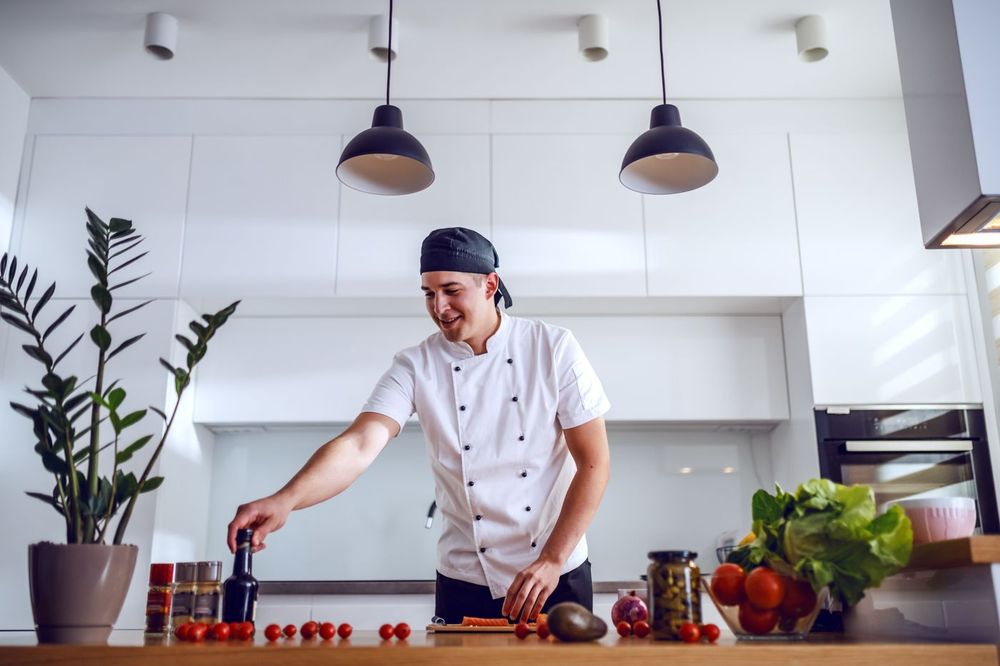

There are things you learn in a professional kitchen that no recipe ever mentions.
They don’t appear in cookbooks. They don’t get covered in the first week of culinary school. They emerge slowly, over years of repetition and failure and standing next to people who have been doing this longer than you have, watching what they do and gradually understanding why.
They are the lessons that arrive late — after you’ve already developed the habits they contradict, after you’ve already made the mistakes they would have prevented, after you’ve already cooked in a way that worked well enough that changing it feels unnecessary.
And yet they are the lessons that change everything. Not incrementally. Fundamentally.
The Best Ingredient Is the One at Its Peak
There is a habit that separates the best home cooks from the rest that has nothing to do with technique or equipment or training.
It is the habit of cooking with ingredients at the peak of their quality — and the discipline of not cooking with them when they’re not.
This sounds obvious. It is, in practice, one of the hardest habits to develop because it requires saying no to a dish you want to make because the ingredient it requires isn’t ready. The tomatoes aren’t ripe yet. The stone fruit isn’t at its peak. The fish didn’t look right at the market today.
Professional cooks who work with seasonal ingredients develop an almost physical sensitivity to this. They squeeze, smell, press, and examine before they commit. They know what a perfect peach feels like under a thumb, what truly ripe tomatoes smell like from across the market stall, what the eyes of a fresh fish tell them before anything else does.
And when the ingredient isn’t right, they don’t use it. They change the dish. They find something that is at its peak and build around that instead.
The late lesson here is that no technique can fix a bad ingredient. The cook who learns to source first, and cook second, produces better food with less effort than the cook who works harder to compensate for ingredients that weren’t worth working with.
Cooking for Others Requires a Different Skill Than Cooking Well
Here is a lesson that surprises many cooks when they first encounter it: cooking excellent food and cooking well for other people are related but distinct skills.
A cook who produces technically brilliant food in isolation — tasting as they go, adjusting to their own palate, finishing at their own pace — may produce genuinely extraordinary results. That same cook, asked to produce the same dish for twelve guests at a specific time, with dietary restrictions, with the constraint that everything must be ready simultaneously, may struggle in ways that have nothing to do with their cooking ability.
Cooking for others requires time management, communication, the ability to hold components at their best while other elements catch up, the capacity to maintain quality under the pressure of a specific delivery deadline. It requires the cook to subordinate their own pace and preference to the needs of the occasion and the people it serves.
Professional cooks learn this early because the kitchen demands it. Home cooks often learn it late — at a dinner party that felt chaotic despite the food being good, at a holiday meal where the cook was too exhausted to enjoy the table they’d prepared.
The lesson is to practice the logistics as deliberately as the cooking. Rehearse the timing. Know which dishes can wait and which can’t. Build a plan that leaves the cook at the table rather than trapped in the kitchen.
Your Taste Is Not Universal
Every cook’s palate is a product of what they grew up eating, what they’ve been exposed to, what they’ve chosen to explore, and what they’ve never encountered.
This is fine. It is also, for a cook who makes food for other people, something to be aware of.
A cook who seasons to their own preference — a palate that happens to love salt, or heat, or acid — will consistently produce food that is perfectly balanced to them and slightly off for someone else. A cook who has never eaten much food from other culinary traditions may not fully understand what a dish from that tradition is trying to do, and may adjust it toward the familiar in ways that change its fundamental character.
Professional cooks learn to distinguish between their own preference and their assessment of a dish’s correctness. They learn to ask not “does this taste good to me?” but “is this dish doing what it’s supposed to do?” The two questions have different answers, and the second one is the one that matters when cooking for others.
This is a late lesson for most home cooks because it requires a kind of culinary humility — the acknowledgment that the palate that feels authoritative is actually personal, and that cooking for others means attending to their experience rather than expressing your own.
The Dish Is Not Done When the Cooking Is Done
There is a rhythm to cooking that professional kitchens understand and enforce that most home kitchens lose in the final minutes of getting a meal to the table.
The cooking ends. The dish is technically complete. And then a series of final moments occur — the rest, the finish, the garnish, the temperature check, the final taste — that determine whether the technically complete dish becomes the actual experience the guest receives.
Home cooks who relax at this stage — who cook with full attention and then rush the last five minutes because the cooking feels done — consistently undermine the work that came before. The steak that needed five more minutes of rest gets cut too early. The pasta that needed a final toss with pasta water gets plated directly from the colander. The sauce that needed a last adjustment of acid goes to the table as it is.
The late lesson is that the final five minutes of getting a dish to the table deserve the same attention as every other five minutes of the cooking process. The cooking is not done until the dish is in front of the person eating it.
Generosity Is a Technique
This lesson doesn’t appear in any culinary manual. It is learned at tables, not stoves.
The best meals are not always the most technically perfect ones. They are often the ones where the cook was most present — most genuinely engaged with the pleasure of feeding people, most willing to pour more wine and send out one more dish and stay at the table past the point where everything was tidied.
Generosity of spirit — the quality of caring about the experience of the people eating more than about the performance of the cooking — is something that professional cooks who last the longest tend to have in abundance. It’s not incompatible with technical rigor. In the best kitchens, they exist together: exacting standards in the kitchen, genuine warmth at the pass.
For home cooks, this lesson often arrives late because early cooking tends to be about the food — the technique, the recipe, the result. The late lesson is that the food is in service of something larger: the occasion, the connection, the particular pleasure of a meal shared with people you care about.
When the focus shifts from “how did the dish turn out?” to “did the people at this table have a good time?” — something changes about the cooking too. It becomes more relaxed, more confident, more honest. The perfectionism that sometimes makes home cooking feel like a performance falls away, and what’s left is something closer to what cooking is actually for.
The Takeaway
The lessons that arrive late in a cooking life are often the ones that matter most — because they shift the relationship with cooking itself rather than just improving the techniques within it.
Cook with ingredients at their peak. Practice the logistics of cooking for others as deliberately as the cooking itself. Distinguish between your palate and a dish’s correctness. Bring full attention to the final five minutes. And remember that generosity — toward the ingredients, toward the people at the table, toward the occasion being shared — is not separate from good cooking.
It is, in the end, what good cooking is for.