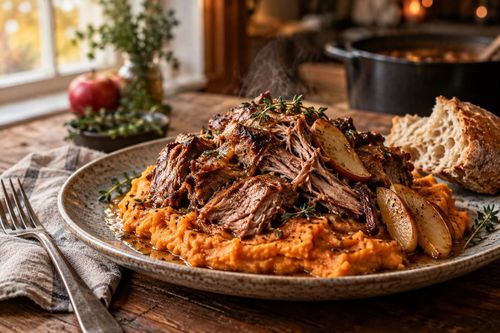



Prime rib occupies a peculiar space in home cooking: it's simultaneously one of the most intimidating cuts to prepare and one of the most forgiving, provided you understand the thermodynamics at play. Slow roasting isn't a trend here — it's the only method that respects both the size of the roast and the structural integrity of its muscle fibers.
What draws me to this cut is the interplay between fat rendering and protein denaturation. A prime rib carries substantial intramuscular marbling, and low, steady heat gives that fat time to liquefy and baste the meat from within, rather than seizing the exterior before the interior catches up.
There's also a precision to it that appeals to my analytical sensibilities. Internal temperature isn't a suggestion — it's the entire game. Get it right, and you have a roast that's uniformly rosy from edge to center. Get it wrong, and you've got a gray ring of overcooked protein surrounding a lukewarm core.
This is a midweek splurge dish, admittedly, but Wine Wednesday exists precisely for moments like this — when the occasion calls for something beyond the ordinary, and a well-chosen bottle can elevate it further still.
The Inspiration Behind This Recipe
I developed this version after years of frustration with recipes that treat prime rib as a high-heat sear followed by a hopeful prayer. The slow-roast-then-blast method solves the core problem: even cooking without sacrificing crust.
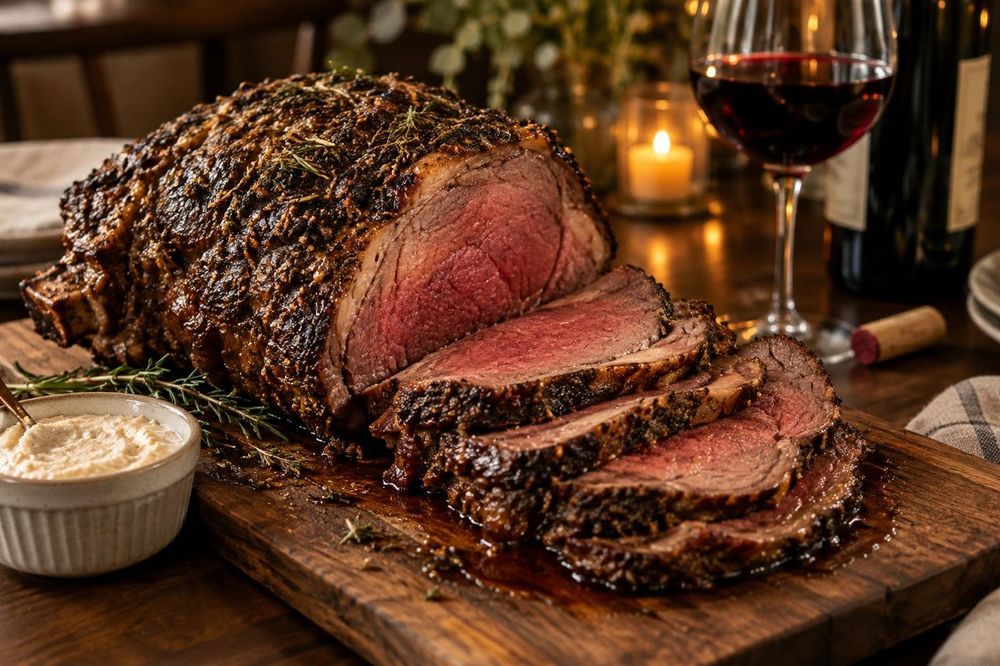
The herb crust came from wanting something that would adhere through hours of roasting without burning — rosemary, thyme, and garlic suspended in a paste of butter and olive oil, applied generously before the low roast begins.
A Brief History of Prime Rib Roasting
Prime rib, or standing rib roast, has been a centerpiece of celebratory dining since the English perfected roasting beef on a spit centuries ago. The American steakhouse tradition cemented it further, turning the cut into shorthand for special-occasion indulgence.
The slow-roasting technique itself gained popularity as home cooks sought restaurant-quality results without professional equipment, relying instead on a reliable oven and a meat thermometer.
Why This Cooking Method Works
Low, consistent heat — around 250°F — allows the roast's internal temperature to climb gradually and evenly. This minimizes the gradient between the exterior and interior, meaning less of that unwanted gray band of overcooked meat near the surface.
A final high-heat sear, done either at the start or end, triggers the Maillard reaction on the exterior, developing the deep, savory crust without compromising the tenderness achieved through the slow phase.
Flavor Profile: What to Expect
Expect a rich, beefy depth amplified by rendered fat, with a fragrant herbal crust that provides aromatic contrast. The texture should be uniformly tender, almost buttery, from edge to center — no tough outer ring, no cool raw middle.
Tips for Making the Best Slow Roasted Prime Rib
Bring the roast to room temperature before cooking to ensure even heat penetration. Use a reliable probe thermometer rather than relying on time alone — pull the roast at 120°F for medium-rare, accounting for carryover cooking. Let it rest, tented loosely, for at least 20 minutes before carving to allow juices to redistribute.
Wine Pairing Guide
- ★ Cabernet Sauvignon — structured tannins cut through the richness of the fat
- Syrah/Shiraz — peppery notes complement the herb crust
- Malbec — soft tannins and dark fruit balance the savory depth
- Bordeaux Blend — classic pairing with structured acidity
- Barolo — for those wanting an earthy, tannic contrast
Serving Suggestions and Side Pairings
Creamy horseradish sauce and a simple au jus are traditional accompaniments that cut through the roast's richness. For a complete midweek spread, consider pairing it with a side reminiscent of our Smothered Asiago Chicken's creamy mushroom notes, swapped for roasted mushrooms alongside the prime rib instead.
Storage, Reheating, and Make-Ahead Tips
Store leftover slices in an airtight container for up to four days. Reheat gently in a low oven with a splash of beef stock to prevent drying out — avoid the microwave, which toughens the proteins. The roast can be seasoned a day ahead and refrigerated uncovered to dry the surface for better crust formation.
Why This Recipe Deserves a Spot in Your Wine Wednesday Rotation
This dish embodies what Wine Wednesday is about: taking a technically demanding process and making it approachable, then rewarding the effort with a glass of something structured and bold. It's accessible luxury, executed with precision.